TL;DR What is the ZEV mandate?
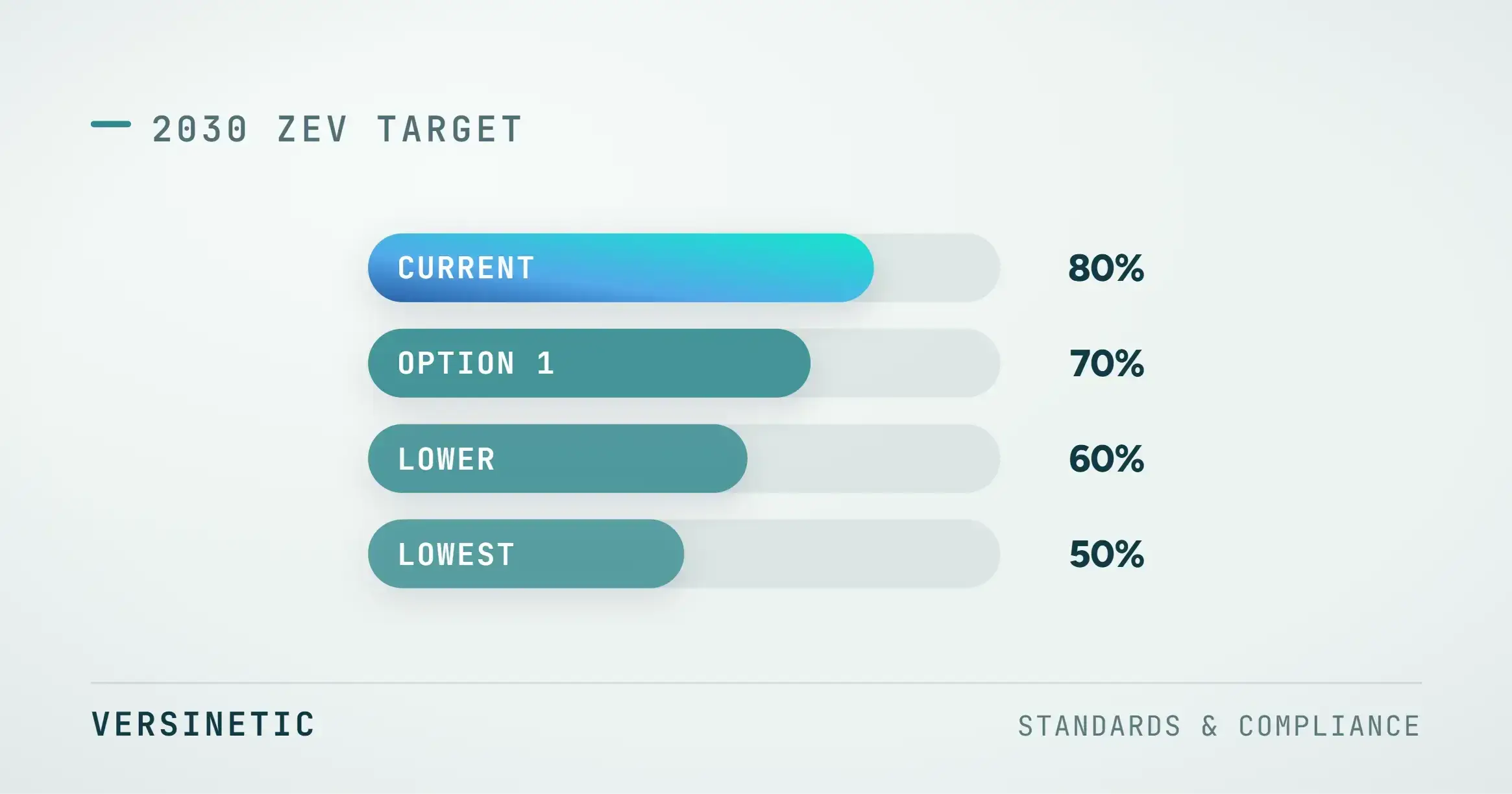
The ZEV mandate sets how many new electric cars manufacturers must sell in the UK each year. That decides how many cars will need charging, and when. For charge point operators and the companies that build their chargers, the mandate’s trajectory feeds straight into utilisation forecasts, site business cases and product roadmaps. The government is reviewing the 2030 car target, currently 80%, with options to cut it to 70%, 60% or 50%. My view is that it should stay at 80%. Targets tend to be undershot, so a lower target lands lower still, and everyone in the charging chain needs a target they can plan against.
ZEV mandate review: open until 11:59pm on 23 October 2026
The government is consulting on whether to lower the 2030 target. Charging infrastructure is outside the review’s scope, so evidence from operators and charger makers is the input most likely to be missing. If you build, fund or run charging, say so in your response, and say what a lower target would do to your plans.
- Respond Online ZEV mandate review response form (https://www.smartsurvey.co.uk/t/x-QEPJ27/)
- Via email zevmandate@dft.gov.uk
- View the Full Document Zero emission vehicle mandate review (PDF)
Why should charge point operators care?
The review is explicit that charging is out of its scope. In the consultation’s words, “charging infrastructure itself is not within the scope of this review” (DfT consultation document, para 81, 2026). Charge point operators are exposed to the outcome all the same, because every site’s business case is built on how many EVs will need charging.
In my view, public charging is relatively expensive partly because many operators are still losing money. Forecourt Trader has reported sector-wide losses, with the head of one major chargepoint firm warning that companies are “running out of money” (Forecourt Trader). They’re running on the assumption that EV numbers will grow fast enough to turn a profit. If the targets are cut, they may never make a profit.
The knock-on effect falls on drivers. If operators start to fail, drivers end up checking Zapmap for whether a charger exists and then for whether the company that runs it is still trading. That uncertainty would put off exactly the drivers the network needs to win over.
Operators have said as much since the review opened. Delvin Lane, chief executive of InstaVolt, warned that softening the mandate at this stage “risks spooking exactly the private capital” the network depends on (EV Fleet World, 2026).
Charger hardware is planned years ahead
The same logic runs further up the chain. A new charger, or a new charge controller inside it, can take years of development before it’s commercially ready. Safety regulation and the work of integrating high-power vehicle systems with the grid both take time. Versinetic’s first charger took about five developer-years.
Anyone committing engineering budget today is betting on the size of the market in 2028 and beyond. Cleantech companies need good signals to give them that confidence, and a target cut midway through the plan works against them.
Whatever the final number, the operators who stay viable will be the ones who keep the cost of each site down. On many sites the grid connection is the constraint. Local load balancing, such as LinkRay dynamic load management, lets more chargers share a fixed supply without a recurring subscription. That matters even more if utilisation grows more slowly than planned. Our public charging networks page sets out where that applies.
What the ZEV mandate review could change
The Department for Transport opened the review on 14 August 2026, jointly with the Scottish and Welsh Governments and Northern Ireland’s Department for Infrastructure (DfT, Zero emission vehicle mandate review, 2026).
Under the current mandate, 80% of new cars a manufacturer sells in 2030 must be zero emission, rising to 100% in 2035. Option 1 in the consultation lowers 2030 to 70%, with interim targets of 36% in 2027, 46% in 2028 and 58% in 2029 (DfT consultation document, Table 2, 2026). The other alternatives take 2030 to 60% or 50%, or keep 80% with extended flexibilities for manufacturers (EV Fleet World, 2026).
Two things do not change under any option. The phase-out of new petrol and diesel cars stays in 2030, and every new car and van must be zero emission by 2035 (DfT consultation document, para 158, 2026). What’s being decided is the shape of the curve between now and then, and that curve is what operators plan against.
What a lower trajectory costs in charging and emissions
Every option ends at the same point. From a charging viewpoint, though, the area between the current target and a lower one is zero emission charging that won’t happen. Each lost point of share is a group of combustion cars that stays on UK roads for the rest of its life.
The UK market was 2,020,520 new cars in 2025 (SMMT, 2026), so every percentage point lost in a single year means about 20,000 fewer battery electric cars. My assumptions are a 14-year average car life, 12,000 km a year, 6.1 km per kWh for an EV, and 150 g of CO2 per km for a combustion car, including fuel refining. On those, each lost point means around 550 GWh of charging that never happens over those cars’ lives. The combustion cars driven instead emit about 504,000 tonnes of CO2, before allowing for the electricity the battery electric cars would have used.
How much growth does each option need?
Let’s start with where the market is. Battery electric cars took 26.2% of new registrations in the first nine months of 2026, against a headline 2026 target of 33% (SMMT, Record electric car market powers bumper September, 2026). In the same nine months of 2025 the share was 22.1% (SMMT, 2025). Volumes grew faster than share, by 30.2% (electrive, 2026), because the whole car market grew by about 10%.
Counting the flexibilities
Headline BEV share isn’t what manufacturers are measured against. Flexibilities lower the share of battery electric cars they need. One is CO2 conversion, which turns CO2 savings from hybrids, plug-in hybrids and other cars into ZEV allowances, subject to annual caps, until 2029 (DfT consultation document, paras 44 and 161, 2026). New AutoMotive puts it plainly: “The estimated real ZEV mandate target stands at 24.6%, after accounting for the flexibilities available under the scheme” (New AutoMotive, Electric Car Count, September 2026). The extra credits come from manufacturers beating CO2 targets on their non-ZEV sales. On that measure, battery electric cars are already ahead.
Plug-in hybrids, with their low official CO2 figures, are a major source of those credits. If all of the flexibility came from PHEVs, each one would count as about 0.6 of a battery electric car: (33% − 24.6%) × total cars ÷ PHEVs = 0.6. On that basis, effective zero emission volumes grew by 32.9% this year:
Projecting to 2030
Total car sales don’t compound the way electric sales do. UK new car registrations have stayed between roughly 1.6 and 2.7 million a year since 2009 (SMMT, 2026), so over time the market’s size is broadly steady. Electric cars are the growth market, because they replace combustion cars, and they will also replace the PHEV flexibilities as those diminish. CO2 conversion currently ends in 2029 (DfT consultation document, para 161, 2026), and I’d expect today’s plug-in hybrid buyers to move to battery electric cars as it does.
That makes effective zero emission volume the relevant measure of growth. If it keeps growing at this year’s 32.9% in a steady market, battery electric share reaches 26.16% × 1.329⁴ = 81.6% in 2030. That exceeds the current 80% target.
This is a projection, and it rests on two assumptions: the market stays at about its current size, and PHEV buyers switch to battery electric cars as the flexibility ends. Counting battery electric cars alone, this year’s volume growth of 30.2% gives about 75% on the same steady-market basis. Measured as share of a growing market, this year’s 18.6% gives about 52%. Every one of those measures clears the 50% option, and the two volume measures clear 70%.
The table below compares what each 2030 option needs with this year’s three growth measures. Choose a measure to see the result.
Ministers say the sales gap is getting harder to close
The government’s case for change should still be considered. The consultation document says the gap between ZEV sales and the mandate targets is becoming increasingly hard to close. It also says manufacturers are finding it harder to hit fast-rising annual targets reliably, citing energy prices, trade and consumer confidence (DfT consultation document, paras 103, 114 and 151, 2026). Transport Secretary Heidi Alexander framed the review as keeping the destination while bringing business along (DfT press release, 14 August 2026).
Nevertheless, the headline gap has widened every year. Battery electric cars took 19.6% of the market in 2024 against a 22% target, 23.4% in 2025 against 28%, and 26.2% so far in 2026 against 33% (SMMT via NFDA, 2025; SMMT via The EV Network, 2026).
That comparison counts battery electric cars alone, against a target manufacturers can partly meet through flexibilities. Those flexibilities were expanded at the industry’s urging, announced in April 2025 and in force from January 2026 (DfT consultation document, para 17, 2026). Once they’re counted, battery electric cars are above the effective 2026 target. Arguing for more PHEV flexibility, then counting only battery electric cars to show how hard compliance is, makes the case for weaker targets self-reinforcing.
Extending flexibilities, while keeping the 80% target, can address compliance problems without telling every investor in the charging chain to expect a smaller market.
There’s a simple mechanism that can help manufacturers and the industry as a whole meet the ZEV mandate whilst providing flexibilities. Check that PHEVs deliver the electric mileage the industry claims, by recording actual zero emission miles against fuel miles at each service or MOT. Where a manufacturer’s PHEVs fall short, it could have ZEV credits revoked or fund extra support to help drivers plug in, such as home or public chargers, or driver education. That would also give the charging industry more confidence, because it means more public charging.
Aiming lower tends to land lower
I’d still commit to the target at 80%, for a reason independent of EVs themselves.
In my experience, societies, governments and industries tend to fall a little short of whatever they aim for. If you aim for 80%, you’re most likely to get somewhat less than that. But if you aim for 50%, because that looks like a reasonable projection, you’ll get even lower.
Setting the target at the current whole market share growth removes the pressure. Fifty per cent looks achievable today because the current mandate has been pushing manufacturers, finance houses and charge point operators towards something higher.
Each extra electric car also cuts what UK drivers spend on running costs. The government’s own figure is a saving of up to £1,400 a year per driver (DfT press release, 14 August 2026). Every car a lower target leaves on petrol or diesel gives up some of that saving.
You want higher targets because you want confidence in the future, and the only way to get that is a higher target rather than a lower one.
Plan your next charger programme with an engineer
Planning hardware for 2028 and beyond, whatever the mandate settles at? Our engineers design charge controllers, firmware and load management for charger manufacturers and operators. Talk to an engineer
ZEV Mandate FAQs
What is the ZEV mandate?
The zero emission vehicle mandate sets the minimum share of new cars and vans each manufacturer must sell as zero emission each year in the UK. Manufacturers that fall short can use flexibilities such as borrowing against future years or transferring credits. It is set out in the Vehicle Emissions Trading Schemes Order, known as the VETS Order.
What are the ZEV mandate targets by year?
Under the current mandate, the car targets are 33% in 2026, 38% in 2027, 52% in 2028, 66% in 2029 and 80% in 2030, then rising by four points a year to 100% in 2035. Van targets reach 70% in 2030 and 100% in 2035. The 2026 review proposed lower interim targets for both.
Why does the ZEV mandate matter to charge point operators?
The mandate decides how quickly electric cars join UK roads, and so how many will need public and workplace charging. Operators size sites, grid connections and investment against that growth. A lower trajectory means slower utilisation, which stretches the time before a site pays back and makes new investment harder to justify.
Will the 2030 and 2035 dates change?
No. The 2026 review keeps the 2030 phase-out of new petrol and diesel cars and the requirement for all new cars and vans to be zero emission from 2035. It covers the yearly targets and flexibilities between now and then, which decide how quickly manufacturers must shift their sales mix.
What happens after the ZEV mandate review? The consultation closes at 11:59pm on 23 October 2026. The Department for Transport will then review the responses alongside the Scottish and Welsh Governments and Northern Ireland’s Department for Infrastructure and publish its response.