One controller, many connectors
Fit multiple EEL boards inside a single charger so more vehicles can charge simultaneously, all driven from one MantaRay.
Hardware Modules · AC Controller
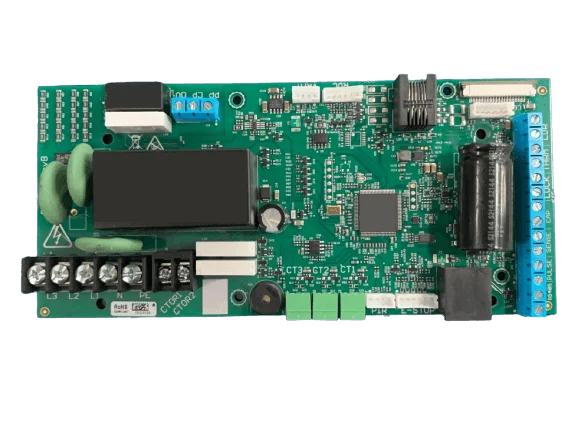
EV AC Charge Point Controller
A compact AC charge point controller that delivers energy straight to the vehicle battery. Compliant with IEC 61851, built for a minimal bill of materials, and designed to work under MantaRay - where a single communications controller can drive multiple EEL boards.
Overview
Where MantaRay handles every aspect of communication, EEL controls the AC power - delivering energy straight to the car's battery in line with IEC 61851. It is the dedicated AC charging block of the charging module range, built to do one job reliably and repeatably.
EEL is designed to work under MantaRay: a single MantaRay communications controller can drive multiple EEL boards, and multiple EELs can be installed in one charger to serve more vehicles at once. Together they manage load balancing across a charging station, so a busy site stays within its supply limit without external hardware.
Feature overview
EEL with MantaRay
A charger built from the charging modules splits the work sensibly: MantaRay owns connectivity, authentication and OCPP, while EEL owns the AC power delivered to each connector. Add EELs to add sockets - one MantaRay keeps them coordinated and balanced.
Fit multiple EEL boards inside a single charger so more vehicles can charge simultaneously, all driven from one MantaRay.
EEL works with MantaRay to share available current across connectors, keeping a busy charging station within its supply limit.
The IEC 61851 charging sequence is handled on the board, so the AC function is compliant out of the box and quick to integrate.
Safety
EEL sits between the supply and the vehicle, so the protective checks are part of the charging function rather than something added around it. It stops the charge on any of the following.
Over current
Charging stops if the vehicle draws more current than the installation allows.
Factory charge limit
The maximum current a given configuration can deliver is set at the factory. EEL never offers the vehicle more than that.
Tilt
Charging stops if the unit moves off normal by a configurable number of degrees, which usually means the enclosure has been damaged or struck.
RDC-DD 6 mA
A DC residual current to earth switches the supply off immediately - the fault path that matters most for user safety.
Over temperature
Both the socket and the board are monitored, and either exceeding its configurable threshold stops the charge.
AC supply faults
Over and under voltage, earth disconnect, live on neutral, and live and neutral swapped all stop charging, as does a PME fault.
What EEL does
EEL concentrates on doing the AC charging job well - controlled power, multi-socket scaling and load balancing - with a compact, cost-conscious design aimed squarely at high-volume manufacture.
AC power control
Manages the AC charging state and delivers energy to the vehicle in line with the IEC 61851 charging sequence.
Multi-socket scaling
Fit multiple EEL boards to one charger so more vehicles can be served simultaneously from the same enclosure.
Load balancing
Coordinates with MantaRay to share available current across connectors and keep the site within its supply limit.
Communications controlled
Takes its instructions from MantaRay, keeping OCPP, authentication and back-office logic on a single controller.
Minimal BOM
A focused feature set and compact layout keep component count and unit cost down at volume.
Compliant out of the box
Standards alignment is built in, so you spend less engineering effort proving the AC charging function.
Why EEL
01
EEL implements the IEC 61851 AC charging function so you inherit a proven, standards-aligned controller rather than developing and validating one from scratch.
02
A compact board and minimal bill of materials keep unit cost and assembly effort low - the economics OEMs need to ship chargers at scale.
03
Install several EELs in a single charger to add connectors, and let one MantaRay coordinate them all with shared load balancing.
04
EEL handles the AC power; MantaRay handles communications, authentication and protocol. Each block does one job well, so your design stays simple.
05
EEL slots into the wider hardware and software range, so you can assemble a complete charger from tested building blocks instead of bespoke development.
06
Versinetic has been building EV charging systems for over a decade. The same team that designed EEL can help you integrate it.
Charging modules
OCPP · Communications Controller
The smart communications controller that drives your EELs - one MantaRay can control multiple boards.
Load Balancing · Up to 100 chargers
Subscription-free dynamic local load balancer for whole-site power management across brands.
OCPP 2.0.1 · Software
Standards-based OCPP 2.0.1 software library, ready to embed in your own hardware under licence.
Get in touch
Tell us what you're building and our engineers will help you scope the fastest, lowest-risk route to market. A conversation directly with the people who design the charging modules.