TL;DR
Commercial vehicle-to-grid (V2G) is live in 2026, but only in a handful of markets: the UK, Germany, France and Australia. It lets a battery EV send stored electricity back to the grid, which turns the UK’s 2.18 million EVs into roughly 109 GWh of distributed storage, nearly doubling the grid’s callable capacity. The barrier has never been the technology; it is regulation. The UK cleared it in 2025 by streamlining G99 approval and bundling it with a certified bidirectional charger and an automatic DNO connection. Most other countries, including EV-leader Norway, are still at pilot stage.
What is vehicle-to-grid (V2G)?
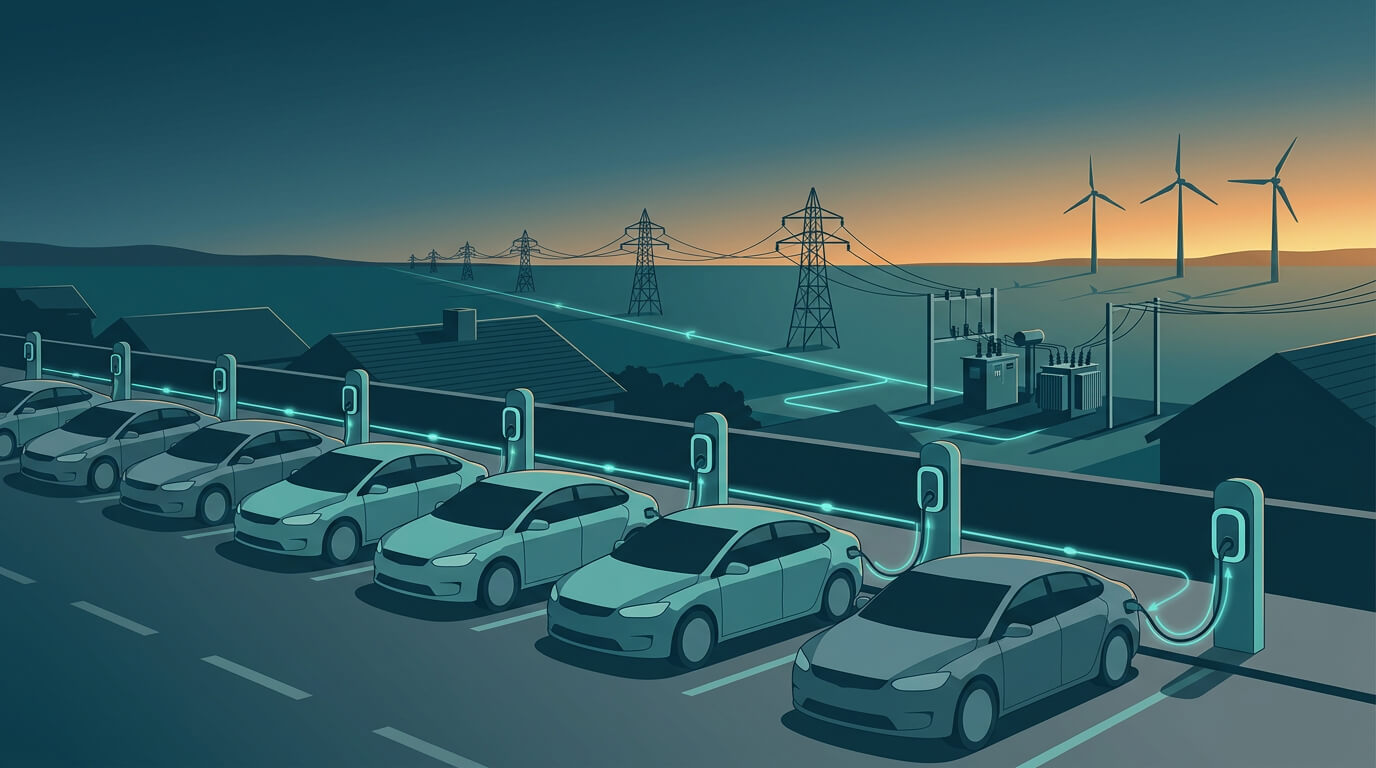
Vehicle-to-grid (V2G) is a technology that lets battery electric vehicles (BEVs) supply electricity back to the grid from their batteries, helping to cover the intermittency of renewable energy. Instead of a car being only a load that draws power, it becomes a two-way store the grid can draw on when demand is high or generation dips.
V2G daily cycle: A single EV across one day: charging overnight on a wind-heavy grid, discharging through the morning and evening peaks, and recharging from solar in between.
After more than a decade of trials, commercial V2G operations are finally here. Versinetic™ catches up on the latest developments and what they mean for the transition to zero-carbon energy. We last reported on V2G in January 2025, when a number of countries were in the process of making it accessible; since then several have fully ratified the regulations.
Why V2G matters for the grid
Energy storage is one of the critical components on the road to net zero. There are several ways to store energy: hydroelectric reservoirs, kinetic flywheels, compressed gases such as air or hydrogen, and battery storage.
As of mid-2026, the UK has about 7.5 GW (137 GWh) of static battery storage. By comparison, the UK passed its two-millionth battery EV in April 2026 and reached over 2.18 million BEVs on the road by August. At an average 50 kWh each, that is a theoretical 109 GWh of storage. Added to static storage, the grid can in principle call on around 246 GWh, nearly double what static batteries alone provide.
EV batteries via V2G nearly double the storage the grid can call on.
What could 246 GWh of storage actually provide?
It could cover our average electricity usage of 30 GW for about eight hours, and that is with no renewables, nuclear, interconnectors or fossil fuels available at all. To put that in context, consider UK electricity usage at 12:45 on 25 March 2026.
A mere 2.4%, 0.96 GW, was being provided by gas. Just 1% of the battery storage we currently have would have cut that to zero, breaking the link between electricity prices and gas and significantly reducing prices for customers.
The 2.18 million BEVs in the UK amount to about 6.6% of UK cars. If 100% of our cars were electric, we could supply roughly 48 hours of current electricity usage with no other energy source available.
For the rest of this decade, V2G on BEVs will likely provide around half of our potential storage, simply because Britons are investing around £20 billion a year (and rising) in electric vehicles. That balance will shift as static storage from cheaper chemistries, such as sodium-ion, comes to dominate production where performance is not critical.
How V2G stabilises a local grid
The obvious purpose of V2G is to provide baseload electricity in normal operation. Its real strength, though, is that it can do this at the level of an individual street or neighbourhood. That means it can cover highly localised loss of electricity, or an unexpected load.
In this way, V2G can help smooth out the grid power fluctuations and oscillations of the kind that led to the Hornsea One blackout in 2019 or the Spanish grid failure of 2025. Those failures were not caused by renewable energy as such, but a significant factor was the build-up of oscillations, which amplified reactive power within the grid until breakers began to trip.
V2G’s second-most important role is to compensate for excess load during upgrades to the National Grid. To be clear, the National Grid is confident it can cope with the transition to EVs. But grid upgrades are still needed in the long term to support the estimated threefold increase in capacity required to electrify everything.
Why can’t a substation just supply a whole neighbourhood?
V2G allows a greater energy supply to neighbourhoods than substations can deliver on their own. Local distribution substations (LDSS) are the National Grid’s leaf node, providing 100 kW to 1 MW, enough for up to a few hundred houses. Individual houses support 80 A per phase, which implies up to 19.2 kW, so 300 houses could in principle draw 5.8 MW, clearly well above an LDSS’s capacity.
UK grid hierarchy: From transmission grid to the street: an LDSS is the grid’s leaf node, and its capacity is far below what its neighbourhood could theoretically demand.
Can a neighbourhood overload its substation?
In future, yes, it would be theoretically possible to exceed an LDSS’s load given current UK charging patterns. EVs tend to charge at night, when general energy usage is low but wind power tends to be high (and will get much higher as wind generation expands by a factor of three or more).
Imagine 300 houses with an average of 1.5 EVs each, where each vehicle needs 20 miles of charge (about 5.3 kWh) over an eight-hour night. Even if wind generation is high enough, that charging produces 296 kW of sustained consumption, frighteningly close to a typical LDSS’s 300 kW capacity.
Supporting that would normally require local and regional grid upgrades. But V2G changes usage patterns to make this less critical, by about 6% according to a German study. With sufficient renewable energy, V2G lets charging spread across the whole 24-hour period, reducing average power to about 100 kW.
LDSS load smoothing - Same energy delivered, but the peak that threatens the substation is engineered away.
For vehicles that stay at home during the day, V2G can also supply domestic power during high demand. Vehicles that travel to work can follow the same pattern: relying on workplace charging where appropriate, then providing grid power in the evening once back at home.
The full daily cycle: home overnight, workplace by day, home again by evening, charging and discharging to match supply and demand.
In other words, V2G is close to an ideal link for solving several critical power problems as we transition to a carbon-free future. It combines mobile energy transfer between available supply and demand with localised capacity optimisation and the intelligence needed to coordinate them, which in turn translates into cost savings and new business opportunities. This is the same territory as our own load balancing work, where the point is to add charge points without reinforcing a site’s grid connection.
Which cars support V2G in 2026?
There is now a substantial range of V2G cars, around the same number as there were EV models available in 2019. Here are 27 of the best in the UK:
| BRAND | MODELS | # |
|---|---|---|
| Renault | Renault 5Renault 4Megane E-Tech EV60Scenic |
04 |
| Volkswagen | ID.4ID.5ID.7ID.Buzz |
04 |
| Mercedes-Benz | CLA 200/250+/350GLC 250/400GLB 250+/350C 400EQS 400/580 |
05 |
| Kia | EV4EV5EV9PV5 |
04 |
| Volvo | EX60EX90 |
02 |
| Alpine | A290A390 |
02 |
| Skoda | Enyaq RSEnyaq 85 |
02 |
| Audi | Q4 e-tron |
01 |
| BMW | iX3 |
01 |
| Hyundai | IONIQ 9 |
01 |
| Polestar | Polestar 3 |
01 |
| # | BRAND | BEVs | % OF BRAND SALES |
|---|---|---|---|
| 01 | BYD | 18,482 |
48.97%
|
| 02 | Renault | 13,312 |
36.62%
|
| 03 | Skoda | 15,326 |
33.12%
|
| 04 | Kia | 18,274 |
29.15%
|
| 05 | Ford | 16,765 |
27.95%
|
| 06 | MG | 12,249 |
24.82%
|
| 07 | Audi | 14,554 |
24.65%
|
| 08 | BMW | 15,068 |
23.76%
|
| 09 | Mercedes-Benz | 12,017 |
23.48%
|
| 10 | Vauxhall | 10,395 |
20.99%
|
| 11 | Hyundai | 9,161 |
20.12%
|
| 12 | Volkswagen | 16,461 |
18.07%
|
| 13 | Peugeot | 7,084 |
16.62%
|
| 14 | Toyota | 4,684 |
10.30%
|
| 15 | Nissan | 2,215 |
5.41%
|
Where is V2G available in 2026?
As of autumn 2026, only a few countries have verifiable commercial V2G availability, though many run pilot projects. The countries worth covering are those with regulatory approval, plus a few instructive exceptions, because the routes to enabling V2G vary so widely.
Australia
Despite being a late adopter of EVs, Australia has been an early leader in moving from trials to commercial V2G and V2H, helped by the large uptake of solar PV across the continent. The government is now making multi-million-AUD investments even in public V2G. Quasar became the first V2G provider in 2025; in the following nine months this expanded to the V2Grid Numbat charger, Amber Electric’s BYD collaboration bringing domestic bidirectional chargers to households, and RedEarth’s Made-in-Australia V2G chargers.
Germany
Germany reached regulation-approved commercial V2G around the same time as the UK. Its first offer is a collaboration between E.ON and BMW, where the EV owner is paid to stay connected and for the grid energy the car provides. In June 2026, Volkswagen and its energy brand Elli announced a second V2G package, with the market launch planned for the fourth quarter of 2026. VW and Elli estimate a potential of €700 to €900 a year for a participating customer in best-case scenarios.
Why did the UK need G99, not G98?
V2G has been technically possible in the UK for a long time, but getting approval meant coordinating several regulations designed for other use cases, prohibitively complex for most users. The key requirements are G98 and G99, covering distributed generation. They are designed for two scenarios:
- G98 covers domestic solar PV installations up to about 3.68 kW (16 A). These export excess energy to the grid, with owners paid a feed-in tariff, and require MCS-certified installers.
- G99 covers commercial renewable-energy installations above 16 A per phase (12 kW for three-phase operation).
From this viewpoint, V2G is simply distributed generation. The problem is that EVs support more than 3.68 kW of generation as standard: single-phase AC domestic charging is about 7.3 kW, and potentially up to 22 kW with three phases. On top of that, a house might easily consume 2 to 4 kW when cooking, or up to 8 kW from an electric shower, so if V2G could only supply a single house it would be of limited value. Practical UK V2G therefore requires G99 approval.
UK regulatory pathway: Why UK V2G needed G99, and how approval was packaged to make it commercial.
The critical steps for the UK were to make G99 approval relatively painless, then to package that approval with a commercial bidirectional charger and a Distribution Network Operator (DNO). By January 2025 the UK government was in the process of ratifying this. It was completed in 2025, and Octopus Energy’s Power Pack is to date the one mainstream, live commercial V2G tariff in the UK. The UK also now has a major DNO, UK Power Networks, providing automatic V2G connection approval, a UK first.
A further UK milestone came from the vehicle side. Nissan became the first car company to gain G99 grid-code certification for an AC-based V2G solution, following a year-long trial at the University of Nottingham, lowering the cost of entry by using an integrated on-board charger rather than a separate bidirectional unit. In June 2026 Nissan and Valeo signed a contract to commercialise bidirectional AC charging stations across Europe, starting in the UK, unveiled at Power2Drive in Munich.
Netherlands
The Netherlands is rolling out V2G on a city-by-city basis, combining it with car-sharing. Utrecht began officially supporting V2G in mid-2025; Eindhoven joined at the end of 2025, followed by Ghent in early 2026.
France
After many trials, France’s approach resembles Germany’s, with products built around auto-manufacturer and energy-provider tie-ins. Renault, Mobilize and Mobility House went commercial in October 2024.
Norway
Despite being the world leader in EV adoption, reaching nearly 96% of new BEV sales in 2025, Norway has yet to break out of pilot projects into commercial realisation.
United States
V2G as a concept originated in a 1997 US research paper, and was coined by an experimental project at a Californian company, AC Propulsion, during the Californian electricity crisis of 2000 to 2001 as a means of stabilising grid frequency. Regulatory changes within the US present numerous obstacles to the EV market, which remains at less than half European and Chinese levels, 8.1% and 7.8% in 2024 and 2025 respectively. Rather than a federal or state-level approach, the US appears to be adopting a proprietary model where manufacturers collaborate with individual utility companies to commercialise a V2G service. A handful of states lead on V2G, including California, Maryland, Massachusetts and New Jersey.
Japan
Japan led the world in commercialising electrified vehicles, notably the hybrid Toyota Prius (1997), then the full-EV Mitsubishi i-MiEV (2009) and Nissan Leaf (2010). But a Japanese preference for hybrids over true EVs has left electrification stagnant: just 30% of new vehicles are hybrids and a mere 1.5% are BEVs.
Japan was, however, the first country to seriously consider V2G as a practical technology, following the magnitude-9.1 Tōhoku earthquake of March 2011, which killed 20,000 people and caused the Fukushima nuclear meltdown. V2G was seen as a way to provide power and battery storage in future emergencies, an obvious concern given how many earthquakes Japan experiences. Early trials used Mitsubishi i-MiEVs and Nissan Leafs, thanks to integral CHAdeMO support. As with many V2G reports, though, it is hard to tell whether these refer to commercial packages, current installations, potential capability, or simply V2G-capable chargers.
Of the roughly 0.8% BEV presence in Japan (283,000 in total), there is a fairly even split between typical European-style EVs and small micro-EVs whose batteries are too small for V2G. The regional variation is even more striking, from 0.19% in Nagano to 0.86% in Tokyo. There are, at last, some indications of a shift towards full EVs, so Japan may yet make progress.
When did V2G finally become commercial?
It has taken roughly 30 years to get from an initial research paper to actual commercialisation, an enormous span in technology terms. It has not been for want of trying. Energy crises have forced the biggest jumps: the Californian energy crisis around 2001 and the 2011 Tōhoku earthquake are the most notable. On top of that, dozens of trials have taken place across multiple continents over about 20 years.
[V2G commercialisation timeline. Thirty years from paper to product, energy crises, not steady progress, drove the biggest jumps.
The main hurdle, as always, is legislation. Grid supplies were designed for large-scale, monolithic delivery from big fossil-fuel power stations. Grid reliability is the direct product of decades of centralised, top-down design, and distributed renewables and storage now invert that whole picture.
So V2G is finally “here”, if you are in one of the relatively few countries or states where it has been ratified. Even then, commercial V2G products are a rat’s nest of bespoke approaches, mostly pairing individual energy providers with auto-manufacturers. In that sense it resembles broadband modem installations at the start of the 21st century, or the UK EV market in 2010.
Versinetic™ has had an inherent interest in V2G for close to a decade, through our load balancing and IEC 61851 / ISO 15118 intelligent AC charging developments, both integral to the success of V2G. Although V2G is nominally here, the gap between reality and potential is so great that we will be tracking it, and driving it forward, for years to come.
Designing charging hardware that has to be V2G-ready?
V2G lives or dies on load balancing and standards-compliant AC charging, the two areas we have built for close to a decade. If you are working through how bidirectional charging fits your hardware roadmap, our engineers are happy to talk it through, engineer to engineer.
See how we work with engineering teams →
FAQs
Is vehicle-to-grid (V2G) available in 2026?
Yes, in a small number of countries. As of 2026, commercial V2G is available in the UK, Germany, France and Australia. Many other countries, including Norway, Japan and most of the US, remain at pilot or trial stage. The Netherlands is rolling out city by city.
Is V2G available in the UK?
Yes. The UK ratified the necessary G99 distributed-generation rules in 2025. Octopus Power Pack is to date the one mainstream commercial V2G tariff, and UK Power Networks offers automatic connection approval for V2G chargers.
Why did UK V2G need G99 rather than G98?
G98 covers small domestic generation up to about 3.68 kW (16 A). An EV exports far more, 7.3 kW on single-phase and up to 22 kW on three-phase, so it exceeds the G98 threshold. Practical V2G therefore requires G99 approval, which was streamlined and packaged with a certified bidirectional charger and a DNO connection.
How much energy storage could UK EVs provide through V2G?
The UK’s 2.18 million battery EVs hold roughly 109 GWh at an average 50 kWh each. Added to about 137 GWh of static battery storage, that gives around 246 GWh, nearly double the grid’s callable storage, or about eight hours of average UK demand with no other generation.
What is the difference between V2G, V2H and V2L?
All three are forms of bidirectional charging. V2G (vehicle-to-grid) sends power back to the electricity grid. V2H (vehicle-to-home) powers a single property. V2L (vehicle-to-load) runs individual appliances or tools directly from the car. V2G is the most demanding because it must meet grid connection rules such as the UK’s G99.
Does V2G damage an EV battery?
Managed V2G uses shallow, controlled charge and discharge cycles rather than deep cycling, and modern battery management systems are designed to limit wear. The daily energy moved for grid support is typically small relative to the battery’s total capacity, so the impact on battery life is modest when the system is properly controlled.