⚡ TL;DR – EV Adoption and SuperSmart EV Charging with ISO 15118
Formerly an emerging standard, ISO 15118 is now a basic requirement for hardware used in EU public charging infrastructure under AFIR. There are firm 2026 and 2027 deadlines for EN ISO 15118-2 and ISO 15118-20.
For the UK, ISO 15118 is not yet written into the regulations in the same way. However, any manufacturer selling products in both UK and EU markets will need to meet the EU deadlines.
At the same time, UK charge point operators are increasingly specifying ISO 15118-ready hardware as a baseline requirement.
For manufacturers, CPOs and procurement teams, the 2027 EU deadline for EN ISO 15118-20 is fast approaching. Hardware decisions being made today will determine whether products reach the market on time.
SuperSmart EV Charging with ISO 15118
One of the biggest challenges to EV growth in the UK has been the complexity of public charging. We’ve passed through early phases of RFID card-based charging provider memberships alongside simple smartphone app membership, then moved into rapid expansion of providers, apps and charge points. We’re now in a period of consolidation, where the focus is on easier payment, higher charging speeds for enroute charging and greater charge point deployment.
The market has come a long way.
According to 2025 figures from UK industry and government sources, BEVs made up roughly one in four new car registrations across the year. The total number of plug-in cars on the road exceeded 2.8 million vehicles, of which around 1.8 million were estimated to be BEVs.
The public charging network grew by approximately 19 per cent over the same period, adding around 14,000 new devices, with ultra-rapid charging (150kW+) continuing to lead in growth terms.
It’s already understood by the industry that the future of charging is for facilities to be universal, particularly with regard to AC destination charging. As development costs spread out and installation becomes more standardised, chargers will begin to be deployed quicker. At the same time, expectation of charging availability will increase – meaning users will be less tolerant of multiple payment systems and different ways of connecting.
Charging becomes simply an accepted part of life, in the same way that Wi-Fi in cafés or device charging on public transport has become normalised and streamlined.
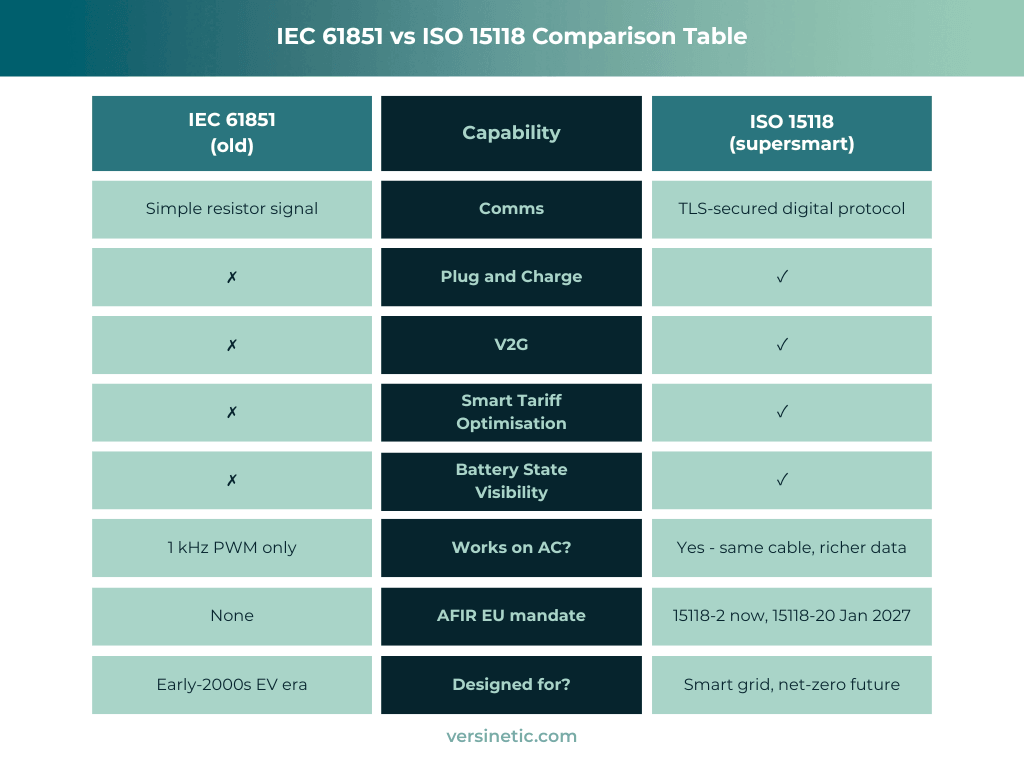
The AC charging protocol, based on the IEC 61851/SAE J1772 standard, has long been too simplistic for present needs. It originated at the beginning of the 21st century for the earliest modern EVs and is really orientated towards hardwired implementations that may even lack any software support. Now, in the mid-2020s, with new mandatory standards arriving in the EU and significant market expectations in the UK, it is not adequate on its own.
The question is how to bridge the gap between increasing sophistication and higher industry standards on the one hand, and ease of use on the other – particularly with respect to AC chargers. Fortunately, a smart charging development from the world of DC charging has provided the answer in the form of ISO 15118.
This is SuperSmart charging.
How Does ISO 15118 Work?
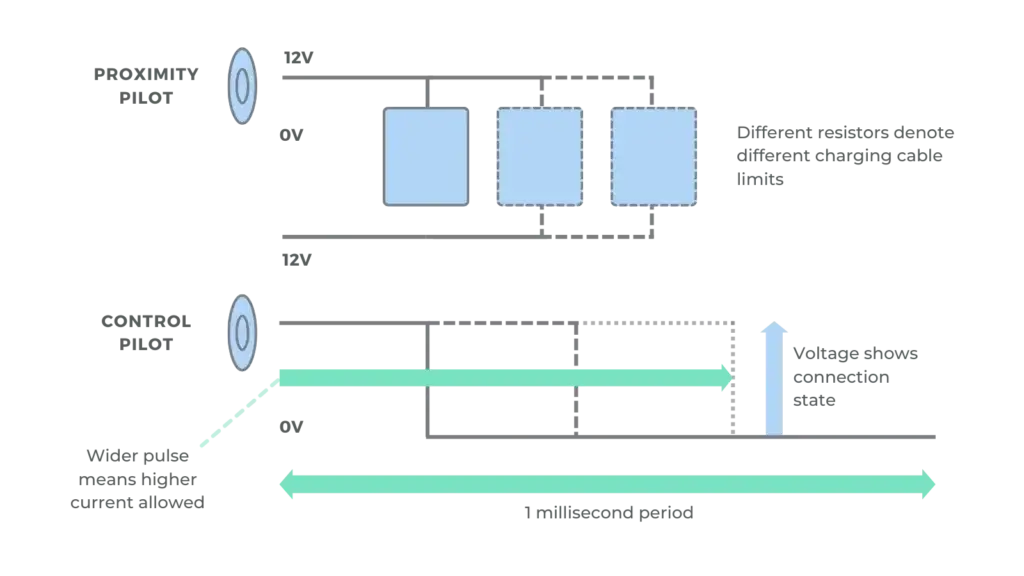
The old IEC 61851/SAE J1772 standard is a simple communications protocol between a charge point and an electric vehicle. It uses two electrical signals.
The first, called the Proximity Pilot, is a simple resistor in the charging cable which is measured by the charger to determine how much current or power the cable can handle.
The second is called the Control Pilot and is a two-way, 12V protocol originally derived from radio-controlled vehicles. The EV is capable of changing the voltage depending on whether it is plugged in or ready to charge, and the charger generates a 1kHz pulse. The width of that pulse tells the EV how much electrical current it is allowed to take.
This was adequate for early adoption, but represents a severe limitation on the capabilities of modern EV technology.
The designers of DC chargers were able to overlay a far more sophisticated, high-frequency, internet-based protocol on top of the same 1kHz Control Pilot signal.
This is ISO 15118.
In some respects, it is similar to the way broadband internet access was overlaid on top of telephone voice communications – same physical wire, entirely different capability.
ISO 15118 was originally designed to work for DC chargers and DC-capable EVs. Engineers then realised it was possible to get ISO 15118 communications to work with AC chargers as well, which opened up numerous possibilities to improve charging for users and providers alike.
What can ISO 15118 do?
Firstly, and most importantly, ISO 15118 provides secure communication using TLS and a V2G public key infrastructure. This secures sensitive data held on the vehicle, including its MAC address, serial number, battery information and importantly, contract certificates.
Because it is possible to obtain vehicle information and contract certificates, it is also possible to enable what is called Plug and Charge capability – the approach Tesla vehicles have long used with their Supercharger network. A user simply plugs their car in, and after the details are transferred, the internet back-end of the charger communicates with a central database so that the owner is automatically identified. Payment is handled without any action required from the driver.
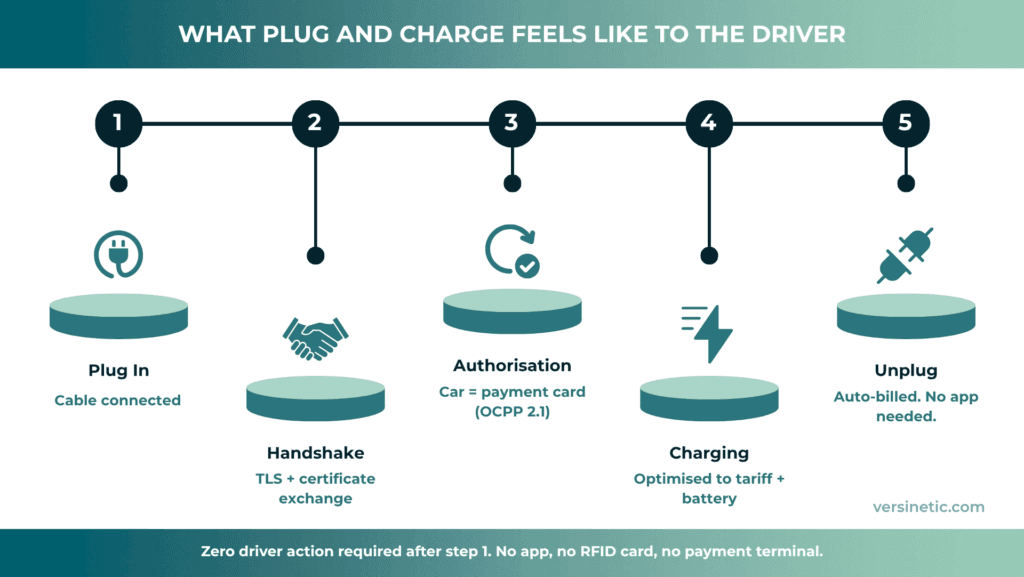
In other words, the car is its own payment card. Because the convention for the back-end is based on OCPP (the Open Charge Point Protocol), compatibility across charge point vendors and vehicle databases is ensured – providing the most seamless charging experience possible.
OCPP 2.1 and the convergence of standards
ISO 15118 and OCPP operate at different layers of the charging stack:
| ISO 15118 | OCPP |
|---|---|
| ISO 15118 governs the communication between the vehicle and the charge point directly | OCPP handles communication between the charge point and the back-office management system |
In January 2025, the Open Charge Alliance released OCPP 2.1, and the relationship between the two standards has become closer.
OCPP 2.1 adds native Plug and Charge support, data models and message flows designed to support ISO 15118-20 features such as bidirectional power transfer and V2X operations, a new functional block for vehicle-to-everything operations, and enhanced integration with distributed energy resources. It is backwards-compatible with OCPP 2.0.1, which means manufacturers can plan a staged migration without wholesale redesign.
Real-world support for these features still depends on the EV and EVSE stacks implementing the relevant options – OCPP 2.1 provides the framework; the charge point hardware and vehicle systems have to follow through.
For anyone building or procuring charging infrastructure today, the relevant question is not simply “does it support ISO 15118?” but:
- Which version of ISO 15118?
- Under which version of OCPP?
- Can the hardware be upgraded in the field without a swap?
- Is it V2X “Ready”?
OCPP 1.6 lacks the native ISO 15118-aligned data models that most ISO 15118-20 and V2G deployments now expect, so new projects should treat 2.0.1 or 2.1 as the minimum version for long-term viability.
Because charging characteristics can be read from a vehicle, charging itself can also be optimised – integrating knowledge about a vehicle’s charging profile with the availability of grid power and energy tariff information. Charging loads can then be better balanced, providing both cheaper and more widespread charging.
ISO 15118 was designed to support V2G from the outset, so vehicles – even with AC connections – can take advantage of periods of high demand to provide power back to the grid. Amongst the wider applications of EVs, the role larger battery vehicles can play in the net-zero transition while their owners are paid for it can hardly be overstated.
The Regulatory Picture: EU Deadlines and UK Expectations
Under AFIR implementing measures, since 8 January 2026 all newly installed or renovated publicly accessible AC charge points in the EU must support EN ISO 15118-2:2016.
From 1 January 2027, all newly installed or refurbished public and private (Mode 3 AC and Mode 4 DC) charge points in the EU must support EN ISO 15118-20:2022. This is the version that brings full Plug and Charge, bidirectional charging capability and TLS 1.3 encryption.
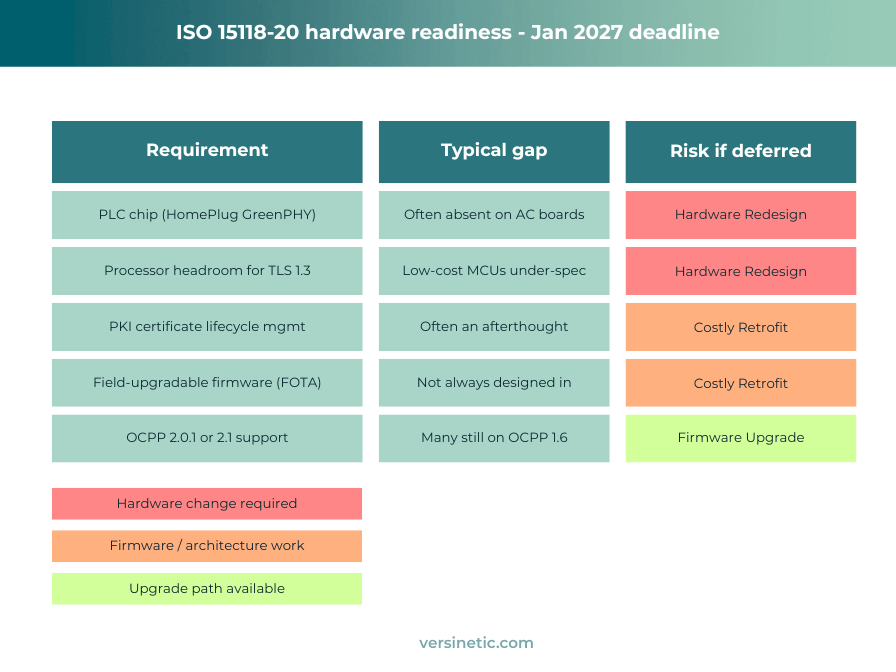
For many manufacturers, this transition represents a significant hardware and firmware undertaking. Many AC charge points currently running on low-cost microcontrollers cannot support ISO 15118-20 without processor and Power Line Communication (PLC) chip upgrades.
Manufacturers who treat January 2027 as a firmware update will find themselves redesigning hardware instead.
For the UK market specifically, ISO 15118 is not yet hard-coded into domestic regulations in the same way AFIR applies across the EU. However, manufacturers placing products on both markets will have to meet the EU deadlines regardless. Particularly as UK charge point operators are increasingly specifying ISO 15118-ready hardware.
UK-specific regulation adds its own parallel requirements:
The Smart Charge Points Regulations 2021
The Smart Charge Points Regulations 2021 imposed security requirements on all manufacturers placing charge points on the UK market, covering protections against unauthorised access, obligations around secure communications and requirements for software update integrity.
The Public Charge Point Regulations 2023
The Public Charge Point Regulations 2023 added further requirements around contactless payment, pricing transparency and network reliability.
A single charge point model targeting both the EU and UK markets usually needs to meet multiple requirements.
For the EU, this includes compliance with ISO 15118-2 and ISO 15118-20 under AFIR. It also typically needs to support OCPP 2.0.1 or 2.1 for back-office system integration.
For the UK, the same hardware must meet the UK’s Smart Charge Points and Public Charge Point Regulations. If vehicle-to-grid (V2G) functionality is included, it may also need to comply with local distribution network operator (DNO) requirements.
Getting this architecture right at the design stage is considerably less expensive than retrofitting later.
Current and Future Scenarios
The vast majority of new public CCS DC fast chargers in Europe now include ISO 15118 support. Older installations are being upgraded where feasible, but legacy hardware without ISO 15118 capabilities still exists and should be considered in fleet planning.
On the AC side, adoption of Plug and Charge has been slower, though the AFIR mandated deadlines are now accelerating it considerably.
Vehicle support has also been uneven. Most DC charging vehicles support ISO 15118 or DIN, whereas Plug and Charge functionality has not been universal – some vehicles requiring software updates and others a hardware upgrade.
Even where a vehicle supports Plug and Charge, the number of charging networks it can authenticate with depends on how many certificates the vehicle can install – on some models only one vendor can be supported at a time. It is always worth checking with manufacturers for the specific level of compliance.
The number of vehicles with some form of bidirectional charging support is, expanding. Models including the Hyundai IONIQ 5, Kia EV6 and EV9, BYD Dolphin, Renault 5 E-Tech and Volvo EX90 support some form of bidirectional charging or V2L, V2H or V2G in selected markets or configurations.
Support for ISO 15118-20-based V2G services, and the certification status for each, varies by model year and region. Procurement teams should verify current status before specifying.
Support for a seamless Plug and Charge experience for end users is driving working groups and conversations focusing on interoperability between vehicle manufacturers, charge point manufacturers and charge point operators.
V2G: moving from trial to commercial deployment
In late 2024, Nissan became the first automotive company to gain G99 Grid code certification with an AC-based V2G solution following a successful year-long trial at the University of Nottingham. It has since announced plans to bring affordable V2G technology to market in the UK.
In mid-2025, Octopus Energy announced a V2G bundle combining a BYD vehicle, a bidirectional charger and a smart export tariff.
UK Power Networks, working with Octopus Energy and others, has begun automating V2G connection approvals for qualifying domestic installations. This helps to remove one of the most persistent administrative barriers to scaling the technology beyond closed trials.
Progress has not been without complications. Industry reports point to a high failure rate in early UK type-testing for bidirectional chargers – demonstrating how challenging it is to take V2G from trial to mass-market product.
As of early 2026, most commercially deployed V2G chargers in the UK are either CHAdeMO-based or AC solutions, with CCS-based V2G still emerging from type-testing into early commercial offerings.
This is a fast-moving area, and procurement teams should check the latest type-test register and product status before committing.
That said, the direction of travel is unambiguous – ISO 15118-20 is the communications foundation on which all of it depends.
What This Means for Manufacturers and Operators
The practical implication of everything above is that ISO 15118 is no longer a feature to be planned for at some future point.
For EU-market hardware, it is a compliance requirement with hard deadlines, and ISO 15118-20 in particular demands hardware decisions that cannot be deferred.
For UK-focused products, the market is moving in the same direction whether the regulation formally requires it or not.
For manufacturers, the critical questions are:
- Can existing hardware support the PLC and cryptographic workloads required by ISO 15118-20 – not just today’s features?
- Can firmware be updated in the field without a hardware swap?
- Has PKI certificate management been designed into the system architecture rather than added afterwards?
Interoperability testing through programmes such as CharIN Testivals is also essential: with hundreds of new EV models expected by 2027. Compatibility cannot be assumed and ad-hoc testing does not scale.
For CPOs and procurement teams specifying AC hardware in 2026, the practical minimum is:
- ISO 15118-2 support today
- A documented roadmap to ISO 15118-20 by January 2027 for EU deployments
- A migration path from OCPP 1.6 to 2.0.1 or 2.1 with field-upgradable firmware
- Hardware with sufficient processing headroom for the PLC and cryptographic demands of ISO 15118-20
- Documented PKI and certificate lifecycle management support
For manufacturers targeting both the UK and EU, AFIR-driven ISO 15118 deadlines apply in the EU, while the Smart Charge Points Regulations 2021 and Public Charge Point Regulations 2023 set parallel UK-specific requirements.
Meeting both from a single hardware design requires careful planning, and the compliance mapping is best done before the product architecture is fixed.
Summary
Seamless SuperSmart charging is no longer a future prospect.
The standards that underpin it are now mandated across the EU, the regulatory deadlines are concrete, and the first commercial V2G deployments are live.
As always, the ideal is for technology to make charging effortless. The complexity that has characterised public charging – multiple apps, RFID cards, varied payment methods – is exactly what ISO 15118 and Plug and Charge are designed to eliminate.
With EN ISO 15118-2 now in force for new public AC installations in the EU – and EN ISO 15118-20 required from January 2027 for all new public and private Mode 3 AC and Mode 4 DC charge points under AFIR in the EU – the direction of the market is clear.
For UK manufacturers and operators, the practical expectation is moving in the same direction, even where domestic regulation has not yet formally caught up.
The manufacturers and operators who treat these requirements as a design constraint rather than a future concern will be better placed than those who don’t.
If you are ready to implement ISO 15118 in your EV charging system, get in touch with Versinetic’s engineering consultants.
Are you working through what ISO 15118-20 readiness means for your product?
Versinetic has been implementing ISO 15118 across multiple charging platforms for several years. Our software stack is designed to support the full Plug and Charge certificate management chain. Get in touch with our expert engineering team.
FAQs
What is ISO 15118 in EV charging?
ISO 15118 is the communication standard that lets an EV and a charger exchange secure digital information, enabling features such as Plug and Charge, smart charging, and bidirectional energy transfer.
Why is ISO 15118 important for EV charger manufacturers?
It is becoming a compliance and product-planning requirement, especially for EU public charging hardware under AFIR, so manufacturers need to design for ISO 15118 support early rather than retrofit later.
What is the difference between ISO 15118-2 and ISO 15118-20?
ISO 15118-2 supports core Plug and Charge functionality, while ISO 15118-20 adds broader capabilities including bidirectional charging and improved security requirements such as TLS 1.3.
Does ISO 15118 work with AC chargers as well as DC chargers?
Yes. Although it was originally developed for DC charging, ISO 15118 can also be implemented on AC chargers to improve user experience, authentication, and future readiness.
How does ISO 15118 relate to OCPP?
ISO 15118 handles communication between the vehicle and the charge point, while OCPP manages communication between the charge point and the back-office system; the two standards work together in a complete charging ecosystem.
What do EV charger designers need to consider for ISO 15118-20 readiness?
They need enough processing headroom for PLC and cryptographic workloads, secure certificate lifecycle management, and a clear firmware and hardware upgrade path for long-term compliance.