
Is there enough lithium in the world for every car to be electric?
Yes. Global lithium availability per capita is roughly 15.1kg, while a person’s practical transport needs require only about 150g—just 1.2% of the available supply. Furthermore, sodium-ion alternatives are now reaching commercial viability.
How fast are EV batteries improving?
Battery performance is currently improving at a rate of 5% to 8% per year. Over the last decade, energy density has more than doubled, while costs have plummeted from over $1,000/kWh in 2007 to under $100/kWh in late 2024.
What happens to EV batteries at the end of their life?
Unlike fossil fuels, batteries are not consumed; they are recharged and eventually recycled. Most EV batteries are finding "second lives" in grid storage or powerwalls before being recycled into new, more efficient cells.
Are solid-state batteries available yet?
While major manufacturers like Toyota are targeting a 2027-2028 release, the first production solid-state batteries reached commercial availability in early 2026 via startups like Donutlabs.
Introduction: Navigating the Batterycene
Summary: The shift from fossil fuel combustion to permanent electron storage is now a commercial reality driven by price stability.
Now lithium prices have stabilised to near record low prices against the past 8+ years; fears of whether “the rEVolution will stall?” or “are they worth it, ethically and commercially?” have receded, while battery technology has continued to make progress and EV sales are resuming steady growth across many global markets.
All this validates the principle that we’re entering further into the age of batteries.
The recent announcement of the world’s first production EV powered by a sodium-ion battery highlights how quickly battery innovation is advancing. Sodium is far more abundant than lithium, improving supply security and cost stability. While energy density is lower, it proves electrified transport isn’t reliant on lithium alone.
Welcome to the Batterycene
We are in an exciting era for battery technology and the case is becoming increasingly compelling. R&D employing hundreds of thousands of people is driving multiple battery solutions for all their possible uses, but before we dive into the details let’s consider the following principles:
- In the past decade or two there has been an explosion of research and development into battery technologies which lever every aspect of battery materials and how they can be applied. Again, this is because the fossil fuel era is coming to an end and we need suitable replacements.
- There is a huge range of possible chemistries, minerals and other materials that can be used to make batteries. This makes it highly likely we can resolve current and future issues.
- In global terms there is an abundance of many and most of these materials, and recent concerns are more of an artefact of prior lack of demand, in turn because most of our energy has come from fossil fuels.
- Battery technology is not consumed, but recharged, reused and finally can be more cheaply recycled into better batteries. Therefore, the rate of resource extraction ought to rapidly decelerate as we approach sufficiency.
- Finally, there is an incredible diversity of battery applications which fit the diversity of uses for energy storage: recharge cycles, recharge and discharge rates, battery energy density, cost, capacity and duration. For example, we don’t use button batteries in a wireless mouse, and don’t use AA batteries in a smart watch.
What ties this all together is the fact that voltage is built from an essentially limitless supply of electrons, which finally frees humanity from its first big idea: burning stuff for all our additional energy needs.
Table of Contents
Research: The 250-Year Journey to the $100/kWh Milestone
Summary: The shift from fossil fuel combustion to permanent electron storage is now a commercial reality driven by price stability.
The Fundamental Blueprint
Key Insight: Modern cells still rely on the core interaction between an electrolyte, anode, cathode, and separator.
The first batteries were developed over 250 years ago, not coincidentally, at the beginning of the industrial revolution. All batteries today still have the same basic structure:
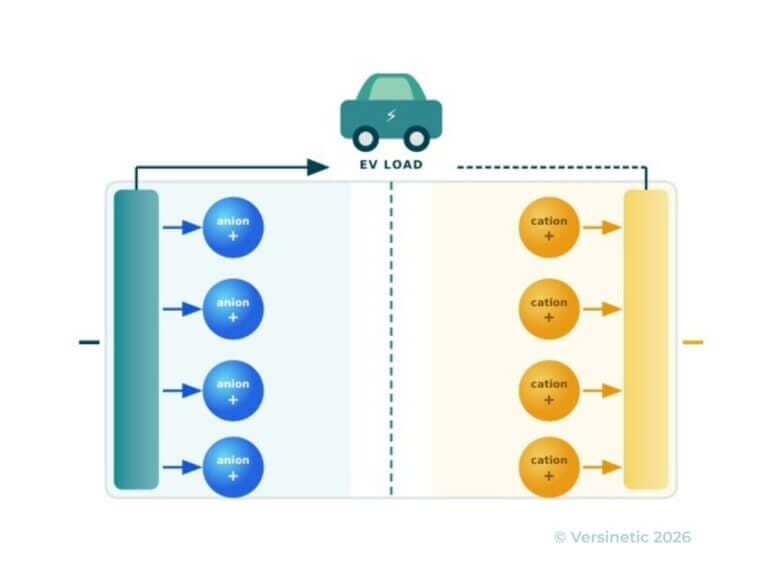
An electrolyte which contains energy stored in electrons which are unable to escape from the material by itself.
An anode, which reacts with its electrolyte when a circuit is made, passing on energy from its electrons to the rest of the circuit.
A cathode, which accepts electrons when a circuit is made, to react with its electrolyte which accepts the electrons.
A separator, which prevents the chemical reactions from completing when the circuit is not made, but allows electrons to be transferred to make up for the imbalance of electrons from each reaction.
A container for the battery which defines its relative capacity as well as its thermal characteristics and influences its cost. The container also hides aspects of the design such as whether the battery is made from multiple cells; whether it’s wet or dry; or whether cells are stacked or in a jelly-roll.
Historical Benchmarks
Key Insight: Applications have evolved from 19th-century Lead-Iron chemistries to the Nickel-Metal Hydride batteries that powered the first modern EVs in the 1990s.
Battery technology progressed intermittently over the 19th century as new chemistries were discovered and new processes were developed to address their short-comings while they expanded into new applications. Some of the oldest chemistries are still used in some applications, such as: Lead-Iron batteries for cars (and even laptops like the Apple PowerBook 100 from 1991); Zinc-Carbon for torchlights or gadgets and Nickel-Cadmium rechargeable batteries for portable phones in the 1990s.
The drive for more powerful applications led to Long-life Alkaline batteries for electronic gadgets from the 1980s; Lithium-button batteries for calculators; Nickel-Metal Hydride batteries in the 1990s (also used in the General Motors’ EV1, the world’s first modern EV); and finally rechargeable Lithium-ion batteries from the late 1990s and into the 2000s for a wide variety of applications: Smart phones; web tablets; EVs; laptops etc.
Where does the word battery come from?
The term ‘battery’ dates back to the 1700s and is credited to America’s founding father, Benjamin Franklin, who was also a scientist and inventor.
Franklin made an analogy between a battery of military units firing in unison for greater effectiveness and his experiments with multiple Leyden jars being discharged in concert.
Franklin's batteries were 'wet' cells, Jars containing liquids, but most of today's batteries are dry-cell types. These are derived from Voltaire’s ‘Pile’, which originally consisted of a battery of 30 cells.
In other words, multiple cells in a battery are the norm. Modern EV batteries take this to the next level with individual cells being assembled into parallel (for power) and series (for range) modules; which in turn are combined into a single battery pack.

The Cost-Density Breakthrough
Key Insight: Since 2014, costs have plummeted while energy density has more than doubled.
Research is exploring every aspect of battery design, which is why EV batteries have increased their energy density from about 150Wh/kg to about 350Wh/kg over the past 10 years. EV battery costs fell below $100/kWh at the end of 2024 from $410/kWh in 2014 and >$1000/kWh in 2007. The main research goals for each component can be summarised as follows:
Component | Research Goals | |
|---|---|---|
Electrolyte | Cheaper Materials | Energy Density |
Thermal Stability | Recharge cycles | |
Anode/ Cathode | Cheaper Materials | Higher Surface Area |
Higher Power Transfer | ||
Separator | Cheaper Materials | |
Container | Volume/Surface Area | Thermal Characteristics |
Structural Integrity | Scalability | |
Engineering vs. Chemistry
Key Insight: Tesla’s 2020 objectives focused on engineering solutions; however, as of early 2026, 4680 cells have made a global impact of only 0.12%, proving that incremental material gains often outweigh single “breakthrough” designs.
Most changes are incremental, but even relatively small changes may contribute to major improvements in battery technology. For example, the Tesla Battery Day presentation in September 2020 focussed on six major objectives which would increase energy density and cost effectiveness by 56%; most of which would be achieved using straight-forward engineering solutions rather than fundamental materials research.
Improvements included a larger battery; a high-power tabless, silicon anode; dry electrodes; continuous motion assembly; no cobalt, Nickel cathodes; batteries as structure. Yet, nearly 6 years later, of the 20.7 million EVs sold globally, around 24 thousand EVs with 4680 batteries were sold (all CyberTrucks), making a global impact of 0.12% against 6%-8% improvements per year.
Yet, Battery research funding is rapidly increasing across the globe.
The EU catalysing €8.2bn of R&D; though the US $3bn in its EV development programme which includes at least $1bn of battery research. Chinese research made LFP batteries a realistic proposition for EVs.
What this means is that we can expect similar improvements in battery capabilities in the next decade or two.
Materials: The Periodic Table of Modern Transport
Summary: Current R&D is diversifying battery components to trade off energy density for longevity and safety.
Although we think of EVs as having Lithium-Ion batteries, in fact their chemistries are different to those in most portable applications (EVs, remember, are also a portable application); primarily because they need to trade-off a slightly lower energy density for far more recharge cycles.
We can summarise the main areas of battery research, against the primary battery components as follows:
Component | Areas of Research | ||
|---|---|---|---|
Electrolyte | Solid State | Interphases | Salt-composition |
Polymer Gel | Dendrite Elimination | Bio-materials | |
Anode | (Synthetic) Graphite | Silicon-Carbon | Lithium Titanate |
Tin/Cobalt Alloy | Surface Area | ||
Cathode | Cobalt Reduction | Aluminium usage | Iron Phosphate |
Lithium-Air | Sodium-ion | Spinels | |
Seperator | Porosity | Tension | Silica Membranes |
Cathode | Cylindrical | Flat Pouch | Cell Size |
Thermal Management | |||
Electrolyte Innovations
Key Insight: Solid-state electrolytes and polymer gels are being developed to eliminate flammability and triple battery lifespans.
- Solid-State electrolytes replace flammable liquid-gel electrolytes in current batteries which improves reliability, but also increases potential energy densities and charging rates.
- Interphase Research aims to reduce battery inefficiencies and damage due to the build up of a chemical layer between the anode and electrolyte over charging cycles.
- Salt-Composition has an effect on the cost and performance of batteries such as their thermal range.
- Polymer Gel electrolytes could triple the lifespan of a battery.
- Dendrite Elimination is critical for eliminating potential short-circuits due to the growth of cathode filaments across the electrolyte during charging cycles.
- Bio-materials can reduce costs and weight while improving sustainability.
Sustainable Anodes
Key Insight: Researchers are moving from energy-intensive graphite toward silicon-carbon and even bio-materials to improve sustainability.
- Graphite permits rapid energy transfer from a lithium-ion electrolyte, but the process is expensive, energy intensive and generates particulates, which synthetic substitutes aim to address.
- Silicon-Carbon anodes aim to improve EV battery range and charging speeds.
- Lithium-Titanate anodes should help to increase the number of charging cycles.
- Tin/Cobalt Alloy may help reduce lithium deposition on anodes.
Surface Area improvements to anodes increase energy delivery and charging rates.
Ethical Cathodes
Key Insight: Major efforts are underway to reduce Cobalt—linked to forced labour—by pivoting to Iron Phosphate (LFP) or Sodium-ion alternatives.
Cobalt Reduction is important because of the use of child and forced labour in manufacturing conventional NMC (Nickel Manganese Cobalt) Lithium ion batteries (as well as the refinement of fossil fuels). The difficulty in tracing the origins of cobalt despite international efforts to regulate other conflict minerals , means there are major efforts to reduce Cobalt use.
- Aluminium Usage could help reduce the cost of backup batteries and improve charging rates.
- Iron Phosphate cathodes are already being used in a number of Chinese EVs as well as Tesla Model 3 cars. They have lower energy densities, but reduce the cost of batteries and the amount of nickel and cobalt.
- Lithium Air cathodes have the potential for the highest energy density of any kind of lithium battery.
- Sodium Ion batteries replace lithium to provide potentially much cheaper EV batteries with energy densities comparable to Lithium ion batteries about 8 years earlier.
- Spinels offer the potential for low cost, environmentally friendly and thermally stable cathode materials.
Next-Gen Membranes
Key Insight: Silica membranes and porosity improvements are critical for increasing discharge rates and thermal stability.
- Porosity improvements are critical for the rate of electron discharge and battery safety.
- Tension unevenness across the separator affects the performance of an EV battery.
- Silica Membranes offer the potential for greater electron discharge, higher levels of safety amongst other benefits.
- Cylindrical Cells in EV batteries can help provide structural strength, ventilation and high energy density per weight.
- Flat Pouch Battery Containers provide flexibility and high energy density per volume.
- Cell Size improvements help to increase energy density, reduce cost and the amount of resources in production..
- Thermal Management is dominated by the container design at the cell, module and pack level, affecting charging rates, longevity and safety.
As we see, the many avenues of current research demonstrate that there is both the potential for a huge amount of improvement over current EV battery technology as well as multiple solutions across the range of EV battery (and battery storage) applications.
Abundance: Debunking the Mineral Scarcity Myth
Summary: A common misconception is that a lack of minerals will limit the green transition.
A lack of basic minerals is often cited in the popular press as a limit on our ability to transition to clean technology, in fact many of the chemistries being explored for current and future batteries are derived from elements which are abundant on Earth relative to our battery needs. A short list follows:
Element | Use | Tonnes | kg/Person (2026) | kg/Person (2021) |
|---|---|---|---|---|
Bromine | Anode | 7,000 | 0.84 | 0.68 |
Carbon | Anode | 554,000 | 66.8 | 54 |
Silicon | Anode | 781 million | 94,000 | 76,000 |
Zinc | Anode | 70 ppm | 23 | 19 |
Potassium | Anode & Cathode | 58 million | 7,000 | 5,600 |
Iron | Cathode | 156 million | 19,000 | 1,500 |
Manganese | Cathode | 3 million | 360 | 291 |
Cobalt | Cathode | 69,000 | 8.3 | 6.7 |
Nickel | Cathode | 84 ppm | 28 | 23 |
Phosphorus | Cathode | 1050 ppm | 361 | 291 |
Sodium | Cathode & Electrolyte | 72 million | 8,700 | 7,000 |
Lithium | Electrolyte | 125,000 (land) | 15.1 | 12.1 |
200 billion (sea potential)* | 24,200 | 24,200 |
*With a predicted 200 billion tonnes of lithium in seawater, supply could be virtually limitless – yet extraction remains the challenge. Researchers are refining five Direct Lithium Extraction methods (adsorption, ion exchange, solvent extraction, membranes, and electrochemical), adapted from desalination technology, though cost and scalability hurdles persist before ocean extraction becomes viable. It’s also worth baring in mind, we can’t extract it all, because marine environments likely depend upon some levels of lithium.
These values are in metric tonnes per person. Many of the values here appear large, but for many minerals only a fraction of these can be reasonably extracted, and only a small fraction of those are really needed for society as a whole.
Consider lithium: For example, a 2016 Tesla Model S with a 73kWh, 453kg battery contains about 63kg of lithium carbonate equivalent (Li2CO3), which amounts to 12 kg of lithium.
The Per Capita Reality
Key Insight: For 100% personal transport, a human only requires roughly 150g of lithium—a mere 1.2% of global availability per person.
Practical transport needs are much lower even for 100% personal transport. At 32km per day; 12km/kWh and 300% utilisation (i.e. each vehicle carrying 3 people across the day), a mere 0.9kWh per person is needed: a tiny 150g of lithium per person or 1.2% of the global availability per capita.
So, given the relative abundance of lithium, we should have been surprised at the high cost of Lithium Carbonate in 2022 to 2023. Yet, as predicted in early 2023, this was really a function of current lithium reserves; a ballooning EV market, added to portable electronics demand rather than global content. In the intervening years, Lithium Carbonate prices fell to historic lows even as EV demand increased by 10 million EVs/year.
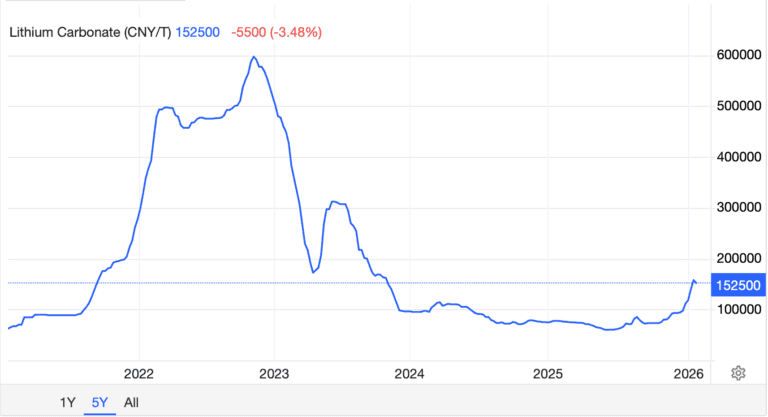
Since 2022, lithium exploration increased by 136% then, along with other EV battery minerals, has levelled off due to oversupply. Even so, lithium extraction may constrain other resources (such as water), be located in unstable regions (such as Iran), or be in protected areas for indigenous populations (for example, North American First Nations sacred land).
The fixation on lithium is also a distraction from the abundance of other materials that can be used for practical battery chemistry. For example, the use of Lithium Iron Phosphate (LFP) batteries in European and Chinese Tesla Model 3 cars means that Cobalt and Nickel can be avoided (the lithium content is still roughly the same, about 160g/kWh).
Beyond Lithium
Key Insight: The rise of Sodium-ion batteries in vehicles like the BYD Seagull demonstrates that we can substitute rarer elements with abundant ones.
Even lithium can be substituted, as the growing interest in Sodium-ion batteries demonstrates. Although Na+ batteries in EVs such as the BYD Seagull (120Wh/kg) were replaced by LFP and the 2025 Yadea mopeds (145Wh/kg) have yet to reach the market, commercial viability is clearly getting closer.
In the end, multiple, abundant materials are usable for batteries, because the key insight is the re-usable storage of energy in electrons, and all elements contain electrons (though not all can easily form the ions needed for energy transfer).
This makes it fundamentally different from historical energy generation, based on burning a material such as fossil fuels or hydrogen to release thermal energy, which can be converted to other forms, like motion, heat or electricity.
Sufficiency: The Circular Economy of Electrons
Summary: Unlike fossil fuels, which are consumed and wasted as heat, battery materials are permanent assets.
As global economies gear up for a net-zero future, treating rechargeable battery production and use as just more consumerism is misplaced, not least because rechargeable batteries are designed to be recharged rather than being single-use.
In reality, EV batteries and emerging battery technology are all new enough for their engineers and designers to have been well aware of the need for recycling before the start of their battery life cycles way back in the late 1990s and early 2000s.
Furthermore, it makes more sense to recycle batteries than extract more raw materials, because it’s far cheaper. In the medium term, we can expect the costs of new battery materials to get cheaper as efforts to find new reserves ramp up, and then get more expensive again as this process becomes more challenging compared with the cost of reuse and recycling.
The Longevity Factor
Key Insight: Real-world data shows exceptional durability; a 2016 Renault Zoe battery degraded only 3% after 125,000 km.
We don’t see much in the way of EV battery recycling yet, but this is because we have found that EV batteries have lasted much longer than most people expected. Consider the author’s 2016 Renault Zoe whose 22kWh battery has degraded by only 3% after 125000 km. Consequently, very few EV batteries have reached end-of-life for EV usage.
Second Life
Key Insight: End-of-life EV batteries are increasingly reused as grid-scale “powerwalls” before being recycled back into raw materials.
It is expected that EV batteries can then perform many more recharge cycles as powerwalls, substations, or substation / renewable energy base loads before they become impractical for commercial usage.
Nevertheless, battery recycling has already been started by Volkswagen, Renault (/Nissan) and Tesla as well as independent recycling facilities.
Battery recycling isn’t even the only option, given the recent announcement of a “paper” battery by Flint, a Singapore startup. Here its cellulose electrolyte acts as a hybrid separator and tackles dendrites. They hope they’ll be viable as EV batteries and when worn out, can be compostable.
Mining Efficiency
Key Insight: By 2040, mineral extraction for clean tech will require less than 1/500th of the mining currently used for the fossil fuel economy.
Unlike fossil fuel extraction, which currently runs at 15 billion tonnes per year, at basically the same rate it is consumed, mineral extraction for clean technology would require less than 1/500th of the mining, by 2040. This is partly due to efficiency gains (⅔ of fossil fuel energy is wasted as heat, and about 40% of cargo shipped is fossil fuels themselves). At the same time, electronic devices are steadily becoming more efficient. Together, these factors mean that over the next few decades, clean technology resources will become highly (if imperfectly) reusable and thus sufficient for our needs.
Diversity: Tailoring Storage for a Zero-Carbon Future
Summary: The versatility of electrons allows for a wider range of applications than fossil fuels ever permitted.
Battery improvements are currently running at a rate of 5% to 8% per year, which if maintained until 2050 will give us between 3.4x to 6.8x better performance. Enough to support the expected phenomenal growth over these decades as we transition towards full decarbonisation in energy production, transport, and manufacturing.
This means there will be many applications for batteries, but it doesn’t mean all those applications have the same battery requirements.
Specialised Storage
Key Insight: Stationary gigafactories may use flow batteries, while high-density applications like the Eviation Alice aircraft require cutting-edge lithium variants.
Consider large-scale gigafactories. They don’t need to be mobile, or compact, so they don’t need to have the same energy density. Here again, Na+ batteries or flow batteries may become the norm, while other renewable energy storage solutions will play important supporting roles, offloading the resource constraints on lithium batteries to true high energy density applications, such as short-haul aircraft, as promised by the pioneering Eviation Alice prototype.
In addition, just because so much attention is given to new battery developments doesn’t mean that established rechargeable battery technologies, such as Nickel Metal Hydride (NiMH) batteries, are obsolete. They too will continue to play a role in existing applications (e.g., rechargeable AA batteries), or novel transport applications now patents have expired.
Solid-State Arrival
Key Insight: While Toyota targets 2027, the first production solid-state batteries became commercially available in early 2026 via Donutlabs.
Diversity means more than energy density. Solid-state batteries have been an industry ideal for the best part of a decade, since they have the potential for more robust battery packs, higher energy delivery, more recharge cycles, with an even lower fire risk than EVs currently achieve (20x lower than combustion cars). Toyota are hoping for a release in 2027-2028. However, in early 2026 they were beaten to commercial availability by Finnish startup Donutlabs.
Smart Infrastructure
Key Insight: Smart grids and “Transport as a Service” (TAPS) will allow smaller, more efficient battery packs to meet the majority of human needs.
As charging infrastructure proliferates, most EV batteries might not need to be as large as they are today. Transport paradigms such as transport as a service (or TAPS, Transport as a public service), currently being pioneered by Waymo and Lyft would increase the diversity of modes of transport.
Smaller 2-person TAPS would provide for the most common cases alongside a minority of vehicles for greater demands (pickups, vans, and HGVs).
As battery infrastructure becomes more pervasive, load balancing and the smart grid will become normalised, making better use of renewable energy and reduce energy costs without compromising our energy needs.
The key takeaway here is that battery technology has an extremely wide application, because electrons have a versatility that was never possible with fossil fuels.
Conclusion: The Defining Factor of Clean Tech
Summary: The 3.5-fold improvement in battery performance over the last 13 years is set to continue as batteries become the backbone of a zero-carbon future.
While Lithium-Ion batteries seem so ubiquitous for today’s technology, it’s easy to forget that a large variety of battery designs have been developed over the course of the past two centuries. With the feverish pace of current battery research, we have seen at least a 3.5-fold improvement over the past 13 years, and all the indications are that this will continue into the next few decades.
Fossil fuels provide many sources as well as many means of refinement to suit multiple applications with different needs, but the much greater flexibility of battery technologies makes them eminently equipped to meet the multiple needs of our zero-carbon future.
This does not mean, though, that the transition will be easy: a significant proportion of global GDP will be required to unlock the potential of battery storage, both for research and deployment. The primary issue faced at the moment is limitations in scaling up battery resourcing to match current and expected demand, rather than any material limitations themselves.
And in the end, this means batteries look set to be the defining factor holding our clean technology future together.
Looking for help with your EV Charging Project?

Versinetic’s editorial team includes engineering specialists who were among the developers that supplied EV chargers for the 2012 London Olympics.
Further Reading & Sources
- World’s First Production EV powered by a sodium-ion battery – TechRadar
- Lithium-Ion Battery Technology: State of the Art and Future Outlook – IDTechEx
- Silicon Anodes Could Help EV Batteries Go Farther and Charge Faster – Reuters
- 200 Billion Tonnes of Lithium in Seawater – Cas
- Advanced Materials for Next-Generation Batteries – Advanced Materials
- Controlling Dendrites in Lithium Batteries – MIT News
- Aluminum–Sulfur Battery Breakthrough – MIT News
- EVs and Solid-State Batteries – Electrek
- World’s First Production Solid-State Battery – CleanTechnica
- BYD Joint Venture Mass-Producing Sodium-Ion EV Batteries – Electrek
- Salt-Based Batteries Smashing Storage Limits – EU Horizon Magazine
- The Battery Industry Has Entered a New Phase – IEA
- Lithium-Ion Battery Pack Prices Fall 20% in 2024 – Energy-Storage.News
- Falling Costs of Battery Packs for EVs – Stockholm Environment Institute
- The Rise of Batteries in Six Charts – Rocky Mountain Institute
- Busting Myths About Materials and Renewable Energy – MIT Technology Review
- EV Batteries and the US–China Technology Divide – MIT Technology Review
- Raw Materials in Tesla Batteries – Electrek
- EU Conflict Minerals Regulation Explained – European Commission
- Lithium Market Prices – Trading Economics
- Winning the Chinese BEV Market – McKinsey
- EU Battery Booster Package – European Battery Alliance