TL;DR
The EV era is still less than 20 years in, meaning the second-hand market is a minority that is only just taking shape. However, macroeconomic pressures have caused a surge in interest from lower-income buyers. This article explores the specific technical challenges, legacy protocols, and infrastructure trade-offs that second-hand vehicle adoption forces commercial networks, hardware designers, and installers to consider. From battery degradation and shifting charging accessibility to charger standards, obsolescence, and grants, we look at how EV ownership distributions are starting to look like the general market, and what that means for smart infrastructure.
When do second-hand EVs shift from minority to market force?
The modern EV era arguably began in 2008 with the introduction of the Tesla Roadster, followed about two years later by the Nissan Leaf.
Since then, the vast majority of EVs sold have been new vehicles, primarily because of the rapid growth rate of the industry and the fact that it takes at least four years on average before a new car owner moves their vehicle on.
The rapid pace of technological progress provides an incentive for those who can afford it to switch to a newer EV.
This means we can safely assume basically all EVs sold up to May 2022 are now in the second-hand market:
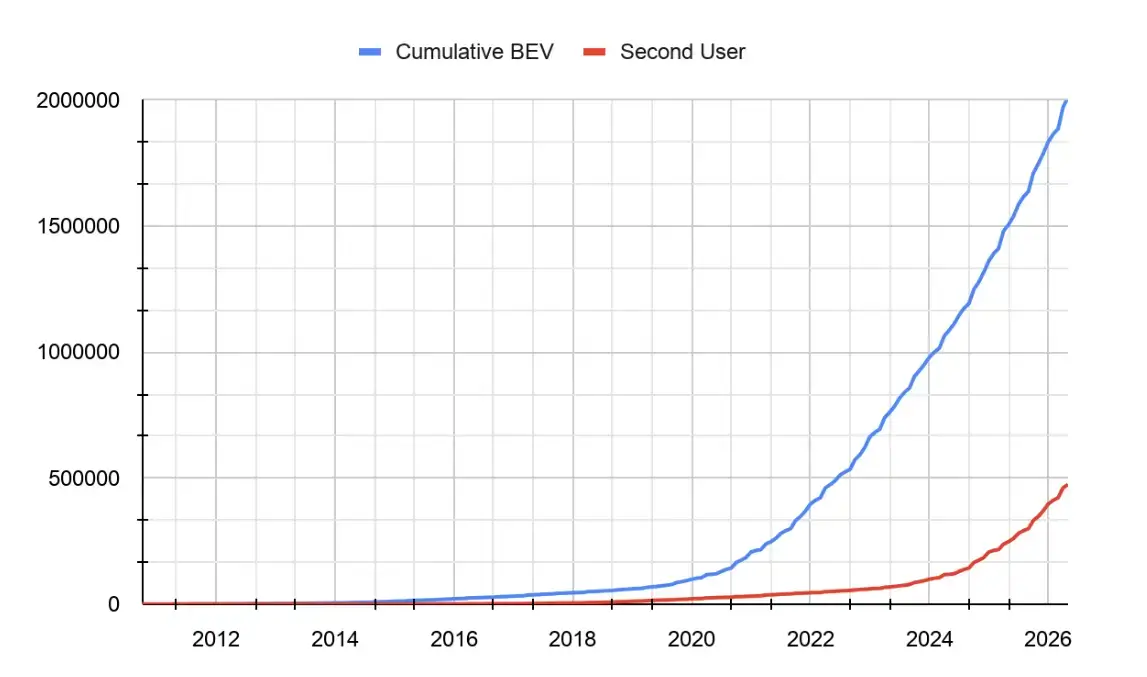
UK second hand EV market growth rate. Source: article author
Right now, there are about 19,000 second-hand EVs entering the UK market per month – roughly half the number of brand-new EVs. On top of that, used EV sales are outstripping historical projections due to ongoing energy and oil market volatility.
AutoTrader’s second-hand EV inventory segment has recently dropped from about 10% to 7% due to surging demand.
For commercial infrastructure providers and charge point manufacturers, it is officially time to focus on pre-loved EVs.
Used electric car battery health: real-world SoH data
At Versinetic, we monitor these trends closely because our own engineering test fleet includes a used EV: a first-generation Renault Zoe bought in early 2017. Recently, upon powering it up, the dashboard greeted us with a notable status reading:
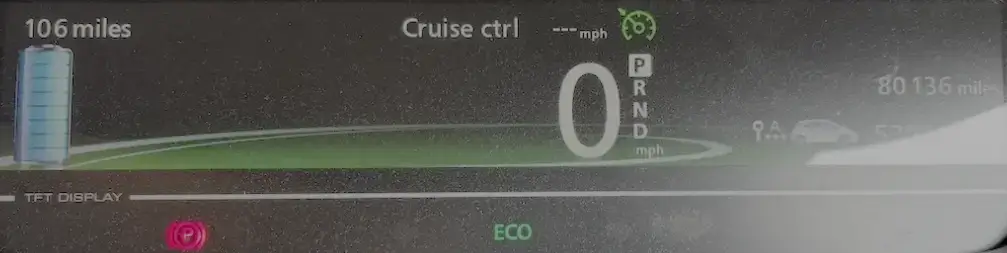
Used EV status reading. Source: article author
106 miles of range after 80,136 miles on the odometer.
This is incredibly impressive given its original 22kWh battery pack, for which we estimate a mere 3% loss of capacity over nine years of continuous use.
Evidently, older EVs remain highly usable if the battery management software and drivers treat them well. The challenge for commercial networks is that predicting this State of Health (SoH) across an entire public fleet is far more difficult than dealing with uniform, brand-new vehicles.
Determining SoH on an older EV is critical. While mechanical parts wear out over distance, it is the battery’s health that dictates its acceptance of fast-charging profiles. SoH certificates are fast becoming a commercial requirement; dealerships like Drive-Green are providing them as standard, while diagnostic services like Aviloo, ClearWatt, and Clevely Motors are moving into the mainstream.
Without standardised embedded certificates, technicians rely on physical units plugged into a car’s OBD diagnostics port alongside vehicle-specific apps like LeafSpy or CanZE.
While individual buyers use these for private sales, hardware manufacturers must design public infrastructure that can seamlessly communicate with these varying vehicular states without triggering false error codes or safety cut-outs.
How far do pre-loved EVs actually need to go?
How these vehicles are used dictates where the charging infrastructure must be deployed.
Most daily journeys remain short: school runs, shopping trips, or modest commutes, with the UK average at around 8.2 miles per trip.
For these general purposes, even the earliest generation of pre-loved EVs, such as the Mitsubishi i-MiEV, Nissan Leaf 24kWh, early Renault Zoe, and BMW i3, are perfectly adequate. They reliably deliver a real-world range of 30 to 50 miles and represent highly affordable access to electric mobility.
However, network operators must account for battery protection behaviours.
Batteries discharged below roughly 20% capacity (or a rule-of-thumb 10 miles of remaining range) tend to degrade more rapidly. To protect the pack, a run-around vehicle still requires a minimum operational cushion of around 26.4 miles.
Because these secondary owners are operating with shorter ranges, their reliance on local, highly accessible public and top-up charging network infrastructure is significantly higher than that of a luxury EV driver with a 300-mile range.
UK chargepoint grants: targeting shared and rented property demographics
Regardless of whether an EV is new or used, access to a dedicated charge point is ideal – but the hardware and installation can be costly.
While an installation invoice is minor relative to the cost of a brand-new luxury EV, it represents a massive proportional expense for a used EV costing between £3,000 and £8,000.
To counter this, the UK government provides a structured, though sometimes convoluted, set of EV chargepoint grants.
Unlike early schemes that were open to any EV owner, current funding is precisely targeted at households that face structural barriers to EV adoption:
-
People living in rented or owned flats (excluding cases where the landlord resides on-site).
-
Properties that rely entirely on off-street parking accommodations.
-
Workplace EV deployment or vehicles leased for more than 6 months.
-
First-time household or business grant applications.
-
Eligible battery electric vehicles (BEVs), which covers the vast majority of the second-hand market.
Crucially, if a previous owner claimed a grant on the vehicle when new, a secondary buyer can still access funding because the grant tracks the household and user combo.
This targeted policy shifts the charging demographic straight toward rented accommodations, multi-unit residential blocks, and high-density street parking – areas where drivers cannot simply drop a cable across a pavement. This is the exact deployment challenge our industry must solve.
Used EV charging compatibility: CHAdeMO vs CCS and ISO 15118 mismatch
The vast majority of domestic and destination chargers across Europe operate at 7.3kW. At a minimum, these chargers require basic signalling to establish connection state and current limits, which was handled perfectly by the earliest industry standard, IEC 61851.
However, the sheer volume of EVs on the grid means charging networks must be far more intelligent to avoid overloading local sub-stations and to leverage low or negative off-peak tariffs. Modern standards like ISO 15118 introduce deep vehicle-to-grid communication, plug-and-charge capabilities, and automated demand-side response.
This creates a clear compatibility gap for second-hand EV owners and the networks that serve them.
Legacy vehicles like early Nissan Leafs, AC-driven Renault Zoes, and older BMW i3 models do not natively support ISO 15118.
Consequently, these vehicles cannot participate in automated, dynamic grid-balancing tariffs, such as Octopus Energy plans that drop from 10p/kWh down to 7.5p/kWh at night based on real-time hardware handshakes.
Legacy Connector & DC Fast Charge Standards by Vehicle
| Vehicle Model | AC Connection Standard | DC Fast Charge Type |
|---|---|---|
| Nissan Leaf (Mk1 / Mk2) | Type 1 US Legacy | CHAdeMO Obsolete |
| BMW i3 (Early) | Type 2 Standard | CCS-2 / Type 2 AC |
| Renault Zoe (Early AC) | Type 2 Standard | AC Charging Only |
Furthermore, hardware physical standards present an ongoing headache, requiring a firm understanding of UK EV charging standards. Nissan Leafs (both Mk1 2011-2017 and Mk2 2018-2025) use a US-style Type 1 AC connector rather than the standard European Type 2 configuration.

L-R: Type 1 connector (SAE J1772), Type 2 connector (Mennekes)
This requires owners to carry dedicated Type 1 to Type 2 adapter cables. For home and destination infrastructure, this reinforces why installing untethered chargers is the most flexible, cost-effective option – it eliminates cable theft risks and avoids cross-generation connector lock-out.
On longer journeys, the issue deepens at the DC fast charger.
Early Leafs rely on the Japanese CHAdeMO fast-charging standard, which has been decisively obsoleted in Europe by the CCS-2 standard.
As networks upgrade, fewer rapid chargers will support CHAdeMO simply because modern platforms – including the upcoming Nissan Leaf Mk3 – have abandoned the protocol entirely.
CPOs must carefully balance legacy CHAdeMO support against the capital cost of transitioning pure architecture to CCS-2-2 DC fast charging.

CHAdeMO connector
UK smart charging regulations: legal pitfalls of second-hand hardware
With the desire to cut installation costs, it can be incredibly tempting for secondary buyers or small commercial properties to seek out cheap, used EV chargers on marketplaces like eBay.
However, the UK’s Smart Charging Regulations mandate that only smart chargers manufactured after June 2022 can be legally installed or commissioned.
While older legacy chargers (like early non-smart ChargeMaster units) function perfectly well on basic protocols, electrical installers cannot legally fit them to a property. This regulatory wall explains why a surge of online sellers are forced to list legacy stock as “faulty” or for parts.
From a commercial design and installation standpoint, Versinetic strongly advises verifying strict regulatory compliance before touching any legacy hardware.
Public charging capacity: modelling demand for UK drivers without driveways
Because the used EVs demographic shifts ownership away from private driveways, these drivers are heavily dependent on public and municipal charging infrastructure. The current landscape shows a massive wave of localised funding initiatives across the UK:
-
A central allocation of £63m specifically for localised EV charging infrastructure.
-
£40.3m earmarked for the Midlands Connect framework.
-
Targeted rollouts including 17,000 points in Hampshire, 1,500 in Oxford, 5,000 in Cornwall, 1,600 in Somerset, and 2,000 in South Tyneside.
-
£6m specifically addressing on-street challenges in North Yorkshire, alongside the nationwide Workplace Charging Scheme.
How do we model the actual capacity needed?
If we look at the 40% of UK households that lack off-street parking, mapped against a national fleet of 32 million cars, and assuming a standard charging frequency of roughly twice per week, the true public infrastructure target sits between 3.2 million and 4.3 million public charging points.
Even if we focus on the intermediate target of reaching 5 million total EVs by 2030, the public network requires an absolute minimum of 500,000 to 672,000 active public charging points.
Progress is being made, but policy roadblocks remain. The industry continues to lobby for critical changes, such as:
1. Reducing the public charging VAT rate down to 5% to match domestic electricity.
2. Implementing software solutions that allow drivers to link public chargers directly to their home electricity provider tariffs.
3. Addressing the watering down of near-term ZEV mandates to avoid market uncertainty.
4. Rectifying the ongoing regional under-investment across Wales.
Grid protection strategies for high-density used EV clusters
Relatively speaking, it is a fantastic time for the second-hand market to expand. In our recent survey within the UK Electric Vehicle Owners Club, the data showed a remarkable shift in consumer confidence:
UK Electric Vehicle Owners Club Survey: Purchase & Lease Profile
How buying habits are shifting between new and second-user EVs
| Purchase / Lease Profile | Share |
|---|---|
| I normally buy new; I bought a new EV | 26% |
| I normally buy second-user; I bought a new EV | 8% |
| I normally buy second-user and bought a new EV, but would buy second-user now | 8% |
| I normally buy second-user; I bought a second-user EV | 46% |
| I normally buy new; I bought a second-user EV | 3% |
| Others | 9% |
Sample size: n = 150 · Source: UK Electric Vehicle Owners Club
-
A central allocation of £63m specifically for localised EV charging infrastructure.
-
£40.3m earmarked for the Midlands Connect framework.
-
Targeted rollouts including 17,000 points in Hampshire, 1,500 in Oxford, 5,000 in Cornwall, 1,600 in Somerset, and 2,000 in South Tyneside.
-
£6m specifically addressing on-street challenges in North Yorkshire, alongside the nationwide Workplace Charging Scheme.
This data confirms that used EVs are no longer a rarity; they are an established market segment.
Yes, secondary ownership introduces more complex trade-offs: slower legacy charge rates, smaller battery capacities, protocol mismatch, and varied states of health.
But on the engineering positive side, these vehicles benefit from years of software updates, optimised battery management systems (BMS), and documented reliability data showing incredibly low mechanical failure rates for EV drivetrains.
As local authorities, CPOs, and commercial property developers race to build out infrastructure for this diverse fleet, charging manufacturers must adapt.
Capturing this market requires deploying smart, compliant systems equipped with LinkRay-style dynamic load balancing. This allows apartment blocks, workplaces, and terraced streets to maximise existing grid capacity, safely serving both legacy and next-generation vehicles without triggering multi-million-pound localised substation failures.
There is plenty to love about the pre-loved EV market – provided your infrastructure software is built to handle it.
Future-Proof Your Charging Hardware for the Evolving Fleet
Talk to Versinetic today to see how our modular communication boards and LinkRay local load-balancing software can insulate your product roadmap against a changing fleet.
FAQs
How do older second-hand EVs impact commercial charging infrastructure?
Older EVs change both the spatial and electrical demands on a network. Because secondhand buyers are statistically less likely to have private driveways, they rely heavily on public, workplace, and shared multi-unit residential charging. These vehicles often operate on legacy protocols and experience slower maximum charge rates, which can increase dwell times at high-demand charging hubs.
Can a legacy EV use modern ISO 15118 smart charging infrastructure?
Yes, but only for basic power delivery. While older vehicles (like early Nissan Leafs or AC Renault Zoes) can physically plug into a modern charger, they lack the internal hardware to handle advanced ISO 15118 software features like Plug & Charge or automated bi-directional communication. The charger must fallback to basic IEC 61851 signaling to safely deliver current.
What are the infrastructure risks of installing second-hand EV chargers?
Under the UK’s Smart Charging Regulations, it is illegal for an installer to fit or commission any charge point manufactured before June 2022 that does not meet strict smart functionality and cybersecurity mandates. Commercial installers and property developers must ensure any hardware deployed is fully compliant to avoid regulatory penalties and grid integration failures.
Why is CHAdeMO infrastructure being phased out across UK networks?
The European and UK markets have standardized completely around the CCS-2 protocol for DC fast charging. Because major manufacturers have abandoned CHAdeMO for new models - and secondary vehicle volumes will naturally decline over time - Charge Point Operators (CPOs) are increasingly rationalising their footprints by removing dual-cable units to reduce maintenance overhead and optimise space for CCS-2 architecture.
Further reading
[1] web.archive.org
[2] https://www.theguardian.com/environment/blog/2011/jan/01/test-drive-leaf-electric-car
[5] https://drive-green.co.uk/dg_blog/battery-soh-certificates/
[6] https://www.bbc.co.uk/news/articles/c2dn5gxxgz1o
[7] https://misterev.co.uk/gear/obd-dongle
[8] https://www.battery-powered.net/blog/measure-soh-battery-renault-zoe
[9] https://www.gov.uk/electric-vehicle-chargepoint-grant-household/eligibility
[10] https://www.versinetic.com/resources/insights/supersmart-ev-charging-with-iso-15118/
[11] https://evpowered.co.uk/electric-car-reviews/nissan-leaf-2026-review-back-to-the-future/
[14] https://www.midlandsconnect.uk/projects/electric-vehicle-infrastructure/
[15] https://www.bbc.co.uk/news/articles/ckgpgy25nlyo
[18] https://democracy.somerset.gov.uk/documents/s55904/LEVI%20Scrutiny%20Report%20July%202025%201.pdf
[21] https://www.northyorks.gov.uk/roads-parking-and-travel/electric-vehicle-charging
[24] https://www.facebook.com/groups/1776102549282259/user/736630789