Unlike mains plugs, there are an enormous variety of EV charging connectors…
Across European, Asian and North American EV manufacturers there are a broad variety of connector types. This often leaves buyers wondering whether their home charger will have the right connector. Or whether on-the-road charging stations will be compatible with their electric vehicle model.
To understand this breadth, we can look to the connector types for the different regions; AC vs DC chargers; and why EV chargers are not simple, 3-pin plugs.
Table of Contents
Why EV connectors aren’t simple 3-pin plugs
In an ideal world, electric vehicles would have 3-pin plugs that you could easily connect to your home electricity. If this were the case, it’s likely that EVs sales would skyrocket and charging solutions would be considerably simpler. However, there are 3 key reasons why simple 3-pin plugs aren’t in the typical EV connector design:
- They don’t take enough current – you would need at least 11kW and up to 43 kW, even for AC connections
- Connectors need to be watertight and rustproof – poor weather could blow your whole mains connection with the current household plug
- EVs need to communicate two-ways with charging equipment – this means we need extra signals, besides positive and negative
For this reason, connector types for EVs are far more robust than your plugs for ordinary sockets.
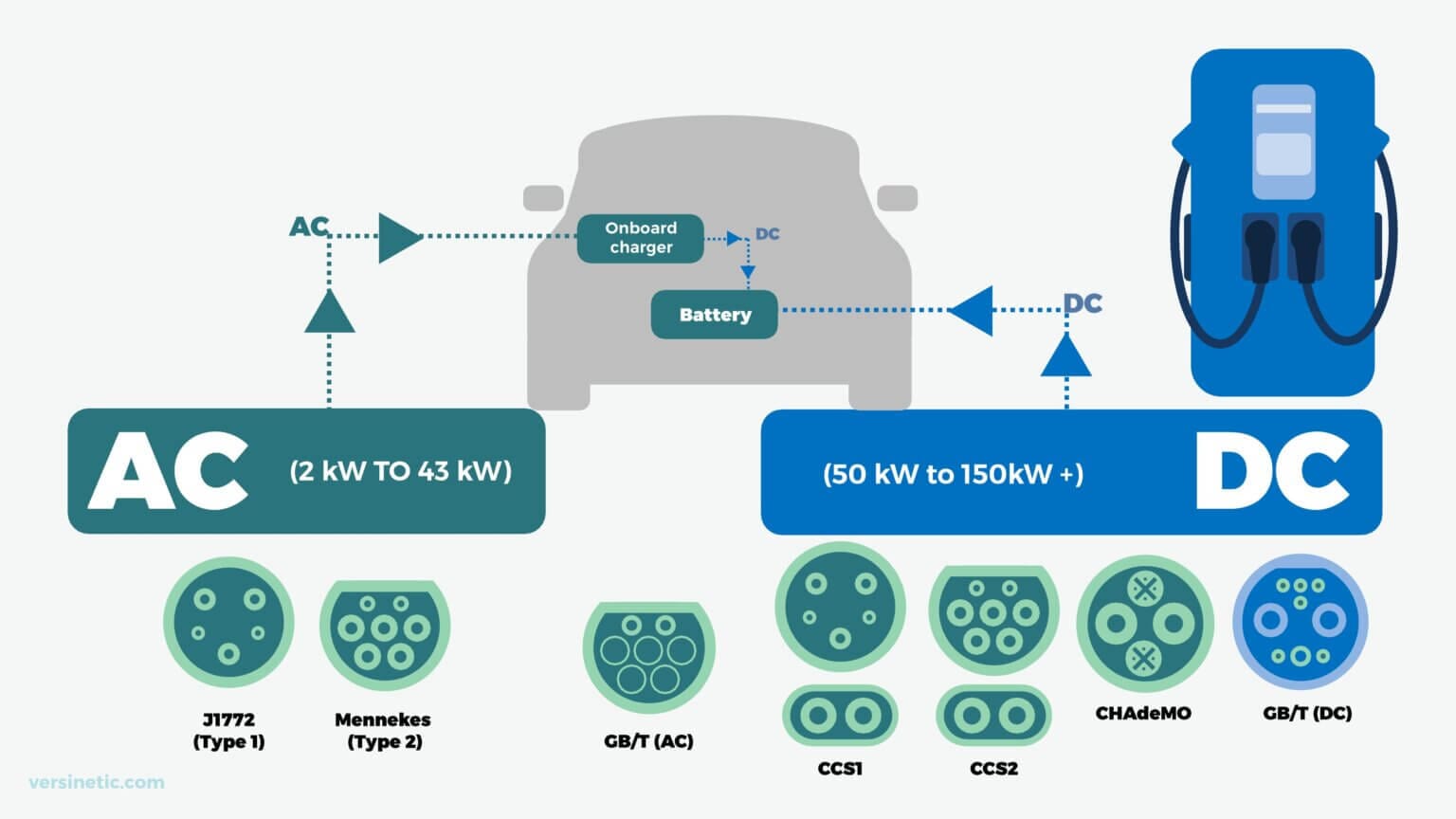
AC Charging Connector Types
There are a variety of AC, EV connectors, which generally vary by the regional manufacturers.
Domestic supplies are typically 7kW, but if plugged into a fast charger, you can reach a maximum of 22kW to charge an EV. In fact, some electric vehicles, such as the older model Renault ZOE, can reach 43kW through the same plug, which is twice the typical charging rate.
SAE J1772 (Type 1) EV Connector – North America & Japan
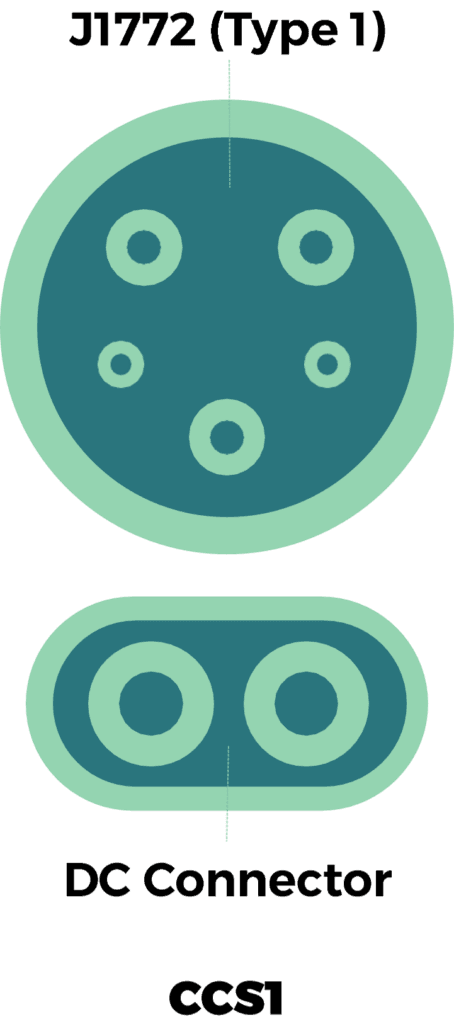
North America was the first continent to formally come up with specifications for EV charging, in the form of J1772 (Type 1). This connector only supports single phase charging and can be found on older electric vehicles from North America and parts of Asia.
They typically support charging rates of up to 7.4 kW and are rarely installed on new vehicles sold in the UK or Europe.
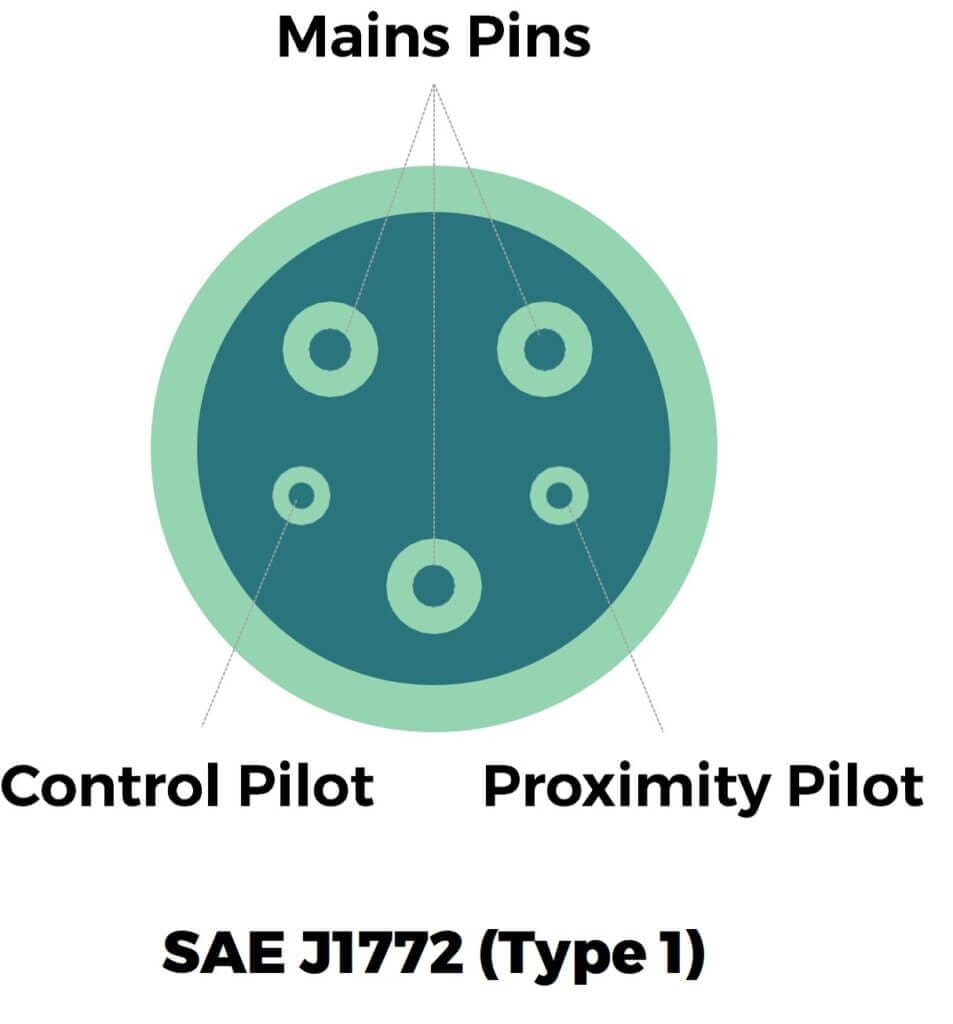
As an AC charger, the J1772 has 3 main pins for carrying the current and 2 smaller pins for communication between the EV and charging equipment. Of the smaller pins:
- The proximity pilot (PP) pin tells the charging equipment the type of cable connected to the socket – different cable thicknesses can cope with different amounts of electrical current
- The control pilot (CP) pin provides bi-directional communications between the electric vehicle and charging system. This checks the maximum amount of current that the EV is able to take at any one time.
Mennekes/ IEC 62196-2 (Type 2) EV Connector – EU & Rest of Market (except China)
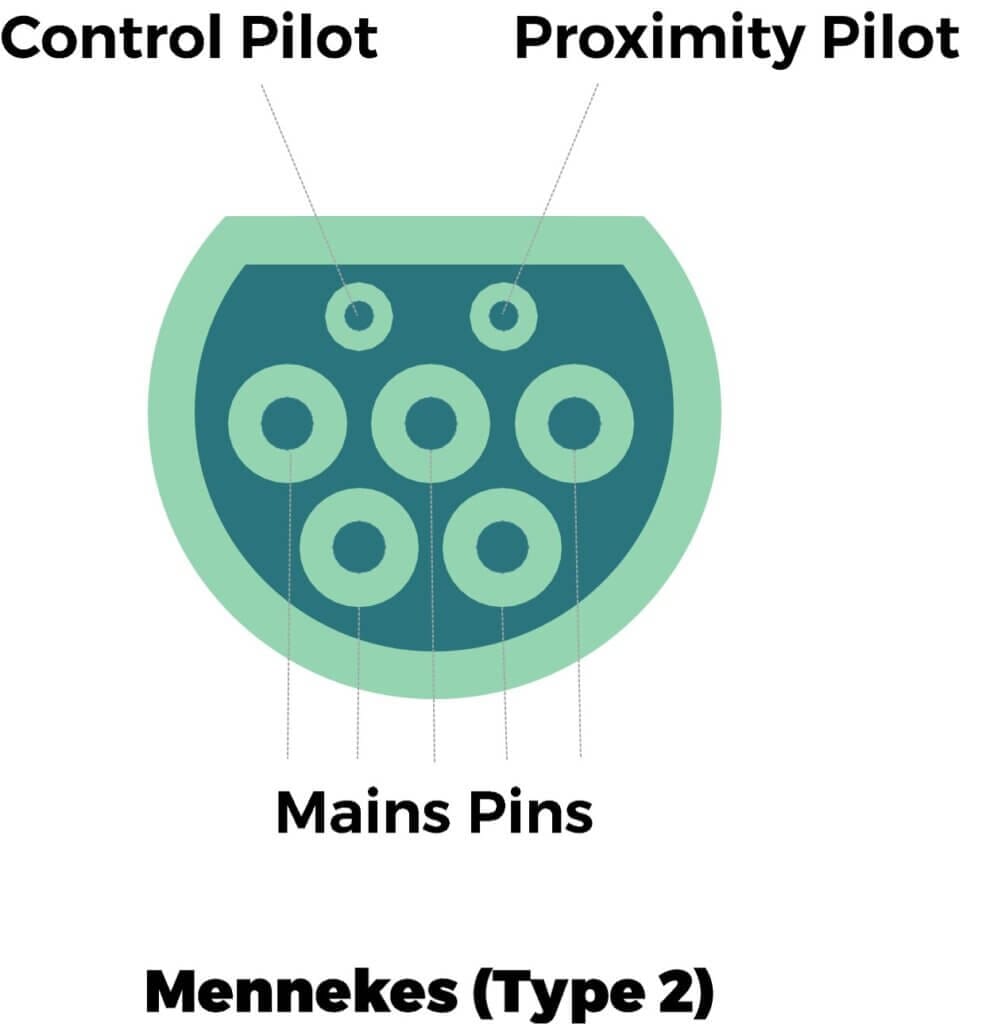
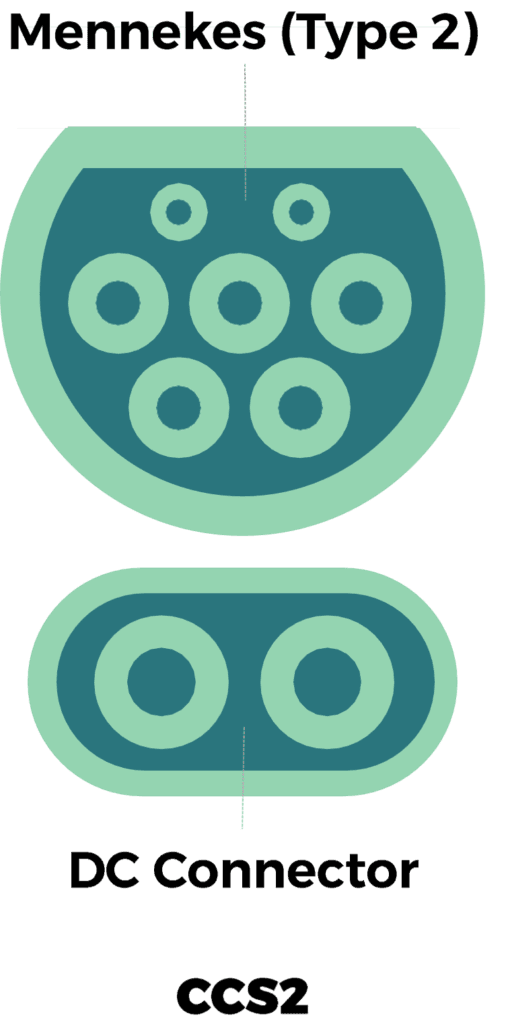
Within Europe, you would rarely encounter a Type 1 charger, instead you would find the Mennekes (Type 2). This has been the official charging plug within Europe since 2013. Most public and domestic charge points in the UK use untethered Type 2 sockets.
Most households only support single phase AC charging. However, as this connector is not too awkward, it can fit in 3 phase electrical supplies (up to 22 kW).
DC Fast Charging Connector Types
DC connectors are typically found at services and within fleet chargers. Rapid DC chargers typically start at a charging rate of 50kW, whereas ultra-rapid chargers can charge at 100-150+kW. Occasionally these can reach as high as 350kw.
Alike to AC chargers, these differ across regions and manufacturers.
CHAdeMO EV Connector – Japan
The first attempt at a DC charger was the Japanese CHAdeMO, which is now used as the official standard in Japan for all DC fast chargers. However, it is considered a legacy DC standard within the UK and Europe.
The CHAdeMO can charge at 50KW, support bidirectional charging and holds 2 pins side-by-side to carry the DC current.

CCS (Combined Charging System)
- CCS1 is used primarily in North America
- CCS2 is the DC fast-charging standard across the UK and Europe
From the late 2010s, the next generation of chargers combined Type1 / Type 2 chargers with a thick DC current connector to create the CCS1 and the CCS2.
CCS2 supports DC charging at power levels exceeding 350 kW, depending on vehicle and charger capability.
CCS uses Power Line Communication (PLC), with ISO 15118 running IPv6 based communication over the charging cable.
This combination connector means that the car is adaptable in that it can take AC charge through a connector in the top half or DC charge via the 2 combined connector parts.
GB/T Connectors – China (AC & DC)
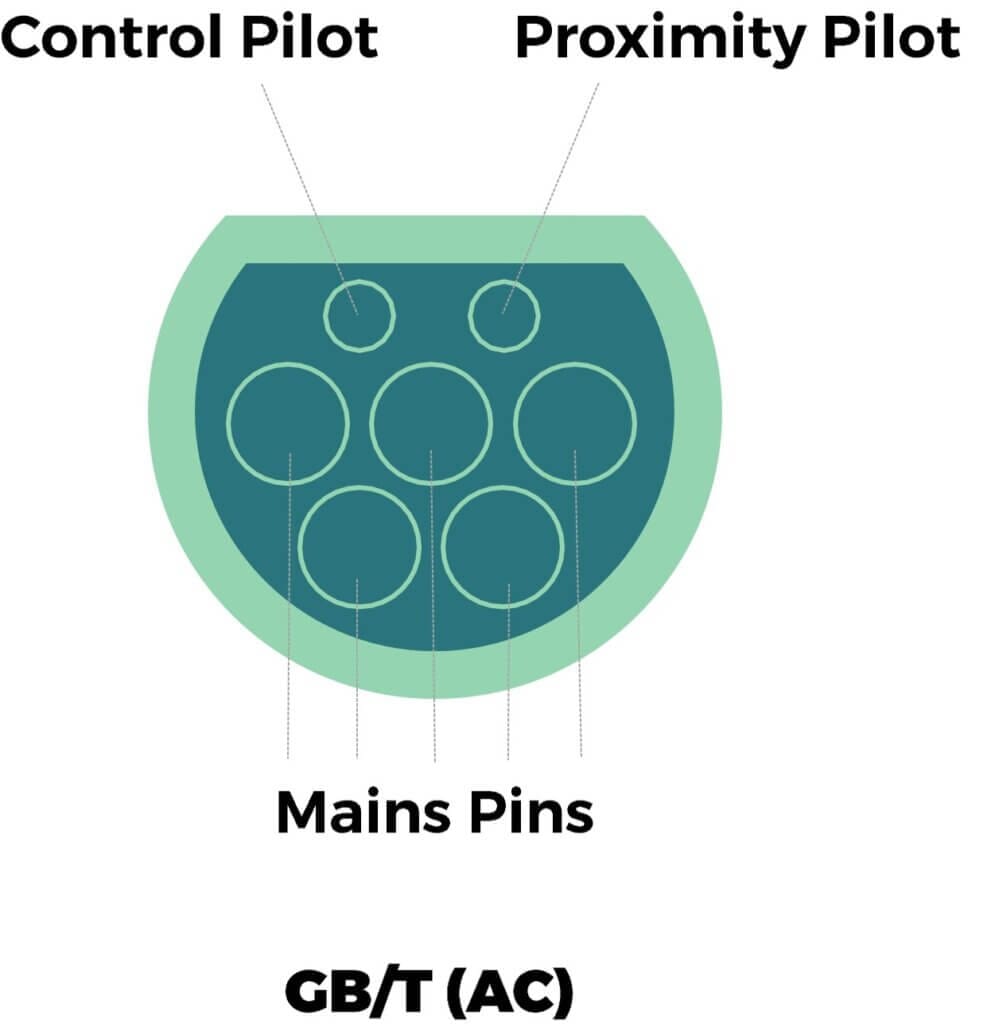
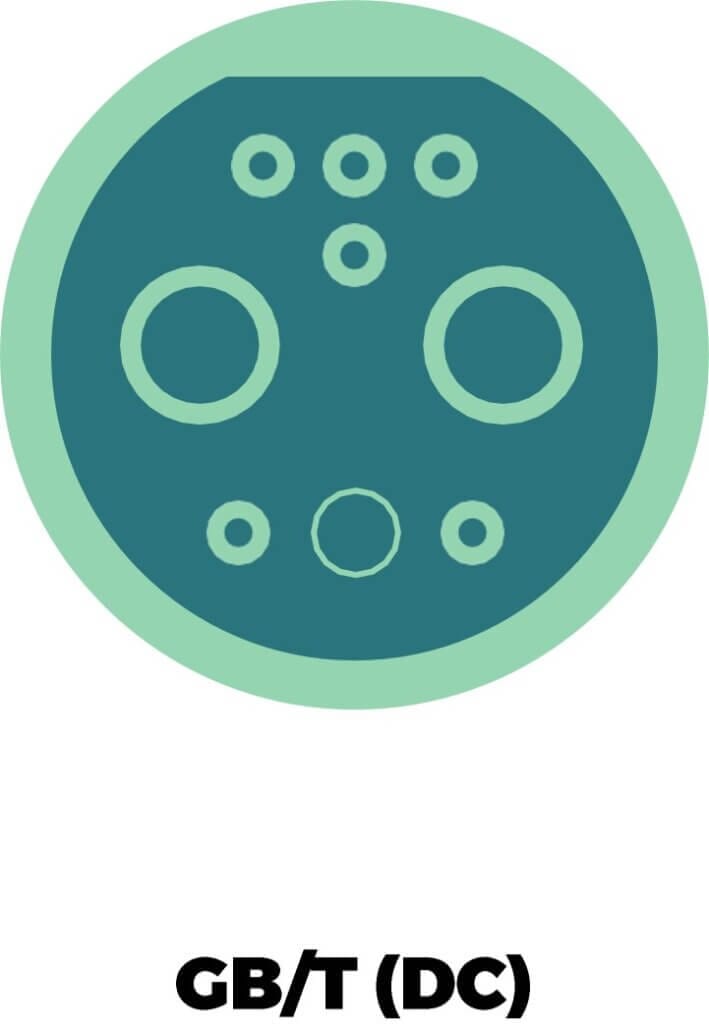
Holding the world’s largest EV market share, Chinese manufactured connectors differ from the rest of the world. China exclusively uses GB/T connectors.
The GB/T (Guobiao standard) for basic AC charging is effectively an inverse of the Mennekes, for basic AC charging. They require dedicated hardware and aren’t interoperable with CCS or NACS without adapters.
Bharat AC001 and DC001 – India (AC & DC)
India has developed its own national EV charging standards:
- Bharat AC001 for low-power AC charging
- Bharat DC001 for DC fast charging
These connectors are designed to support India’s specific infrastructure and cost requirements and are becoming increasingly important for manufacturers operating globally.
EV Charging Connector Comparison Table (2026)
Connector Type | Charging Mode | Typical Power Range | Primary Regions | Current Status (2026) | Key Design & Specification Notes | |
|---|---|---|---|---|---|---|
Type 1 (SAE J1772) | AC | Up to 7.4 kW (single phase) | North America, legacy imports | Legacy | Rare in UK installations; may require tethered cables or adapters for imported vehicles | |
Type 2 (IEC 62196-2) | AC | 3.7 kW – 22 kW (up to 43 kW legacy) | UK, Europe | Standard | Mandated AC connector for UK/EU; typically untethered; supports single & three-phase | |
CCS1 | DC | 50 kW – 350 kW+ | North America | Active | Used alongside NACS; relevant for global charger platforms | |
CCS2 | DC | 50 kW – 350 kW+ | UK, Europe | Dominant DC standard | Primary DC connector for UK public rapid charging; required for future-proof EU deployments | |
CHAdeMO | DC | Up to 50 kW (higher in limited cases) | Japan, legacy EU vehicles | Declining / Legacy | Still required for some existing vehicles; often included as secondary connector on rapid chargers | |
Tesla (EU) | AC / DC | AC up to 22 kW / DC up to 250 kW+ | UK, Europe | Integrated into CCS2 | Tesla uses Type 2 (AC) and CCS2 (DC); no longer a proprietary EU connector | |
NACS (SAE J3400) | AC & DC | AC up to 19.2 kW / DC 250 kW+ | North America | Rapidly expanding | Not used in UK yet; important for global designs and export markets | |
GB/T (China) | AC & DC | AC up to 22 kW / DC up to 250 kW+ | China | Active (regional) | Requires dedicated hardware; not interoperable with CCS/NACS | |
Bharat AC001 | AC | Up to 3.3 kW | India | Active (regional) | Low-power, cost-focused standard; not relevant to UK installs | |
Bharat DC001 | DC | Up to 15 kW | India | Active (regional) | Entry-level DC standard; superseded in many cases by CCS2 in India | |
Plugging in the Various EV connectors…
Using an EV connector does not just boil down to the amount of current we want, or communicating the correct amount of data between the EV and charger. Instead, manufacturers must also consider that the physical charger needs to be plugged in and the connector cable itself has to be ‘lugged’ to the vehicle. Therefore, there are many factors that go into the design, including:
- Weight of connector cable
- Where in the car it connects to
- The shape & complexity of connector
- The locking/anti-locking system.
All of these aspects affect how easy it is to charge an EV.
It is often found that the Mennekes is one of the easiest cables to connect, over the more awkward CHAdeMO plug. In addition, CHAdeMO and CCS both lock the connector during active charging for safety. Type 2 uses an electromechanical locking pin controlled by the vehicle and charger.
Having said that the Mennekes is fairly simple to plug in, when you move to the CCS2 (Mennekes + DC cable), the double connector makes it slightly trickier to line up with the connector on the car.
To charge faster with the connector, a thicker cable would allow more current. However, this would be heavier and more cumbersome to wield, making charging harder.
Communication Protocols and Smart Charging
Modern EV charging is no longer defined solely by physical connectors. Communication protocols play a key role in security, billing and grid integration. Future-proofing is now as much about software and communication standards as physical connectors.
ISO 15118 and Plug & Charge
ISO 15118 enables:
- Automatic vehicle authentication
- Encrypted communication
- Plug & Charge functionality (no RFID or app required)
- Vehicle-to-Grid (V2G) capability
This is increasingly expected in new public DC infrastructure, particularly in Europe.
OCPP
OCPP is an open, vendor‑neutral communication protocol used for communication between EV charge points and a central management system (back office). It enables network operators to monitor, control, and manage chargers remotely, regardless of manufacturer. OCPP is maintained by the Open Charge Alliance (OCA).
OCPP operates between the charger and backend, not between the charger and the vehicle (that role is handled by ISO 15118 or DIN 70121).
OCPP Enables:
- Remote start/stop of charging sessions
- User authentication (RFID, app, Plug & Charge coordination)
- Meter values and billing data
- Charger status, faults, and diagnostics
- Firmware updates
- Smart charging and load management (version‑dependent)
OCPP Versions:
Most widely deployed version globally
Short Lived and superseded by 2.0.1
Most advanced and future-proof version
The Future of EV Connectors…
It’s unlikely that the kW charge will reach much higher than current levels. For most passenger cars, battery sizes are expected to cluster around 60–100 kWh, with larger packs remaining niche Currently, 50 kWh gives drivers 200 miles range. It’s not necessary that the everyday car will need much more than 400 miles.
Of the EV connectors, it has long been predicted that the CHAdeMO will eventually fall into disuse. European EV models (Audi, BMW, Renault, Mercedes, Volkswagen & Volvo) all favour the CCS & Type 2 chargers.
Historically, Asian manufacturers (Nissan & Mitsubishi) have favoured the CHAdeMO and Type 1 chargers. However, an increasing number of these Asian manufacturers are now switching to European AC standards for their next generation models.
Future-proof charger design now requires not only connector compatibility, but also support for advanced communication standards and modular hardware architectures.
FAQ — EV Charging Connector Types (UK)
What is the most common EV charging connector in the UK?
The most common EV charging connector in the UK is Type 2 (IEC 62196-2) for AC charging and CCS2 for DC rapid charging. These connectors are mandated by European standards and are used by the vast majority of new electric vehicles and public charge points.
What connector should be specified for new EV chargers in the UK?
New EV chargers in the UK should be specified with Type 2 sockets for AC charging and CCS2 connectors for DC rapid charging. These standards ensure compatibility with current and future electric vehicles sold in the UK.
Is CHAdeMO still required on UK EV charging infrastructure?
CHAdeMO is no longer required for most new UK installations. It is considered a legacy connector, but may still be included where there is a clear need to support older electric vehicles that rely on CHAdeMO.
Do Tesla vehicles in the UK use a different charging connector?
No. Tesla vehicles in the UK use Type 2 connectors for AC charging and CCS2 connectors for DC fast charging, the same standards used by other manufacturers. Tesla no longer uses a proprietary connector in the UK or Europe.
What is CCS2 and why is it important?
CCS2 (Combined Charging System Type 2) is the standard DC fast-charging connector in the UK and Europe. It enables high-power charging and supports modern features such as Plug & Charge, making it essential for public rapid and ultra-rapid EV charging infrastructure.
What is NACS and is it used in the UK?
NACS (North American Charging Standard), also known as SAE J3400, is primarily used in North America. It is not currently used in the UK, but is relevant for manufacturers designing EV chargers for global markets.
Are all EV charging connectors compatible with all vehicles?
No. EV charging connectors vary by region and vehicle. In the UK, most vehicles are compatible with Type 2 and CCS2, but imported or older vehicles may require adapters or alternative connectors.
What is ISO 15118 and does it affect connector choice?
ISO 15118 is a communication standard that enables Plug & Charge, secure authentication and Vehicle-to-Grid functionality. While it does not change the physical connector, it is increasingly important when specifying modern EV charging equipment.
Should new EV chargers be future-proofed for changing standards?
Yes. New EV chargers should be future-proofed by supporting CCS2, Type 2, ISO 15118 and modular hardware designs. This helps ensure compatibility with future vehicles and evolving charging requirements.
Why are different EV charging connectors used in different countries?
Different EV charging connectors exist due to regional regulations, historical development and grid requirements. While global standardisation is improving, regional differences such as CCS2 in Europe and NACS in North America still remain in 2026.
Versinetic’s editorial team includes engineering specialists who were among the developers that supplied EV chargers for the 2012 London Olympics.